McKay, R.M., De Santis, L., Kulhanek, D.K., and the Expedition 374 Scientists
Proceedings of the International Ocean Discovery Program Volume 374
publications.iodp.org
https://doi.org/10.14379/iodp.proc.374.203.2026
Data report: bulk sedimentary organic matter concentrations and isotopes at IODP Expedition 374 Site U1521 in the Ross Sea, Antarctica1
Felipe Stanchak,2 Ethan Goddard,2 Justin Dodd,3 Anna Buczynska,3 and Amelia E. Shevenell2
1 Stanchak, F., Goddard, E., Dodd, J., Buczynska, A., and Shevenell, A.E., 2026. Data report: bulk sedimentary organic matter concentrations and isotopes at IODP Expedition 374 Site U1521 in the Ross Sea, Antarctica. In McKay, R.M., De Santis, L., Kulhanek, D.K., and the Expedition 374 Scientists, Ross Sea West Antarctic Ice Sheet History. Proceedings of the International Ocean Discovery Program, 374: College Station, TX (International Ocean Discovery Program). https://doi.org/10.14379/iodp.proc.374.203.2026
2 College of Marine Science, University of South Florida, USA. Correspondence author: [email protected]
3 Department of Earth, Atmosphere, and Environment; Northern Illinois University; USA.
Abstract
International Ocean Discovery Program (IODP) Expedition 374 drilled Site U1521 on the outer shelf of the Ross Sea, Antarctica. Site U1521 is composed of seven lithostratigraphic units consisting of diamictites, mudstones, and diatomites. We present low to moderate resolution records of bulk sediment-derived total organic carbon (TOC), total nitrogen (TN), and carbon and nitrogen isotopes (δ13Corg and δ15N, respectively) from the uppermost ~300 m of Site U1521. Measured TOC values range 0.39–1.55 wt%, and TN values range 0.03–0.14 wt%. δ13Corg values range −28‰ to −22‰, and δ15N ranges 2‰–8‰. Generally, geochemical trends correspond with lithologic variations at Site U1521. Diamictites contain lower %TOC, %TN, and δ13Corg and higher δ15N and TOC/TN ratios. In contrast, diatom-bearing/-rich mudstones contain higher and more variable %TOC, %TN, and δ13Corg and lower and more variable δ15N and TOC/TN. These general trends indicate that organic matter sources shifted as depositional environments changed during the Miocene and Pliocene.
1. Introduction
International Ocean Discovery Program (IODP) Expedition 374 drilled at five sites in the Ross Sea, Antarctica, to investigate the past response of Antarctica’s ice sheets to ocean forcings (McKay et al., 2019a). Site U1521 (75°41.0′S, 179°40.3′W; 562 m water depth) was drilled on the outer continental shelf in the Pennell Trough to test hypotheses related to ice sheet behavior and forcing in the Ross Sea from the Miocene to recent (Figure F1) (McKay et al., 2019b; Pérez et al., 2022; McKay et al., 2024). Site U1521 consists of a single hole drilled to a total depth of 650.1 m core depth below seafloor, Method A (CSF-A), which recovered 411.50 m (63% recovery) of lower Miocene to Pleistocene sediment. The recovered sedimentary sequence consists of seven lithostratigraphic units that reveal variations in depositional environments between ice-proximal and ice-distal settings (McKay et al., 2019a; McKay et al., 2024). Herein, we focus geochemical analyses on sediments from Lithostratigraphic Units II–V (~27–287 m CSF-A). Units I and II (0–85 m CSF-A) of Site U1521 consist of interbedded diamictites, diatom-bearing/-rich muds and mudstones, and muddy diatomites. Unit III (~85–209 m CSF-A) contains diatom-bearing/-rich mudstones. Unit IV (~209–281 m CSF-A) consists of diatom-bearing sandy diamictite with basalt clasts, and Unit V (~281–324 m CSF-A) contains chert nodules and mudstone. (McKay et al., 2019a).
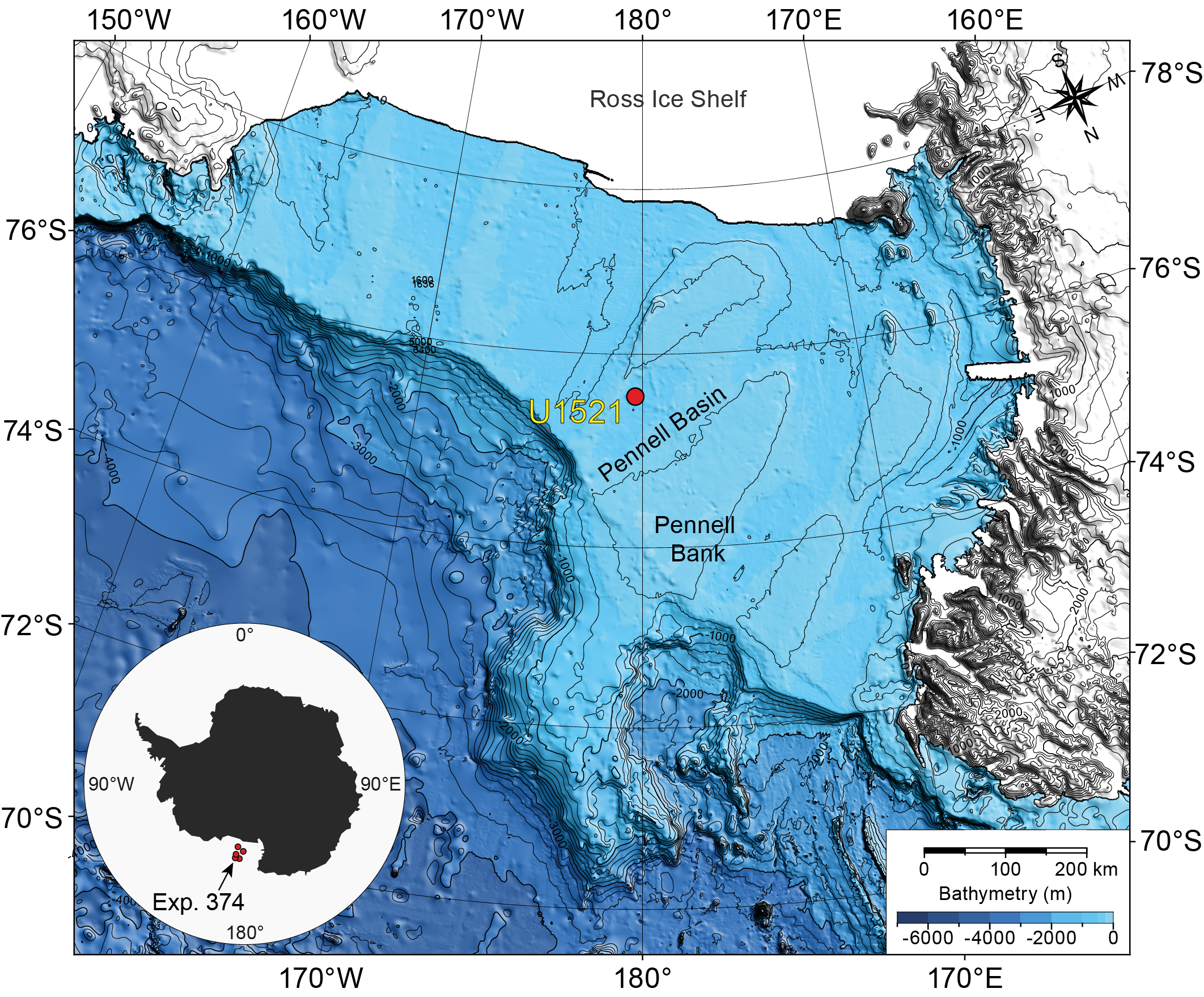
Figure F1. Map of Ross Sea.
Organic geochemical proxies, including total organic carbon (TOC), total nitrogen (TN), TOC/TN, δ13Corg, and δ15N are used to reconstruct oceanographic processes and identify the sources of organic materials to Antarctica’s continental shelf sediments (Smith et al., 2019, and references therein). In subglacial to ice-proximal environments, diamictites often contain terrestrially derived organic matter delivered to the sediments by advancing ice sheets and tend to have TOC/TN values >10. In contrast, in ice-distal shelf settings, sediments often contain organic matter from different sources (e.g., reworked terrestrial and marine) with TOC/TN values around ~10. In open marine environments, diatom-rich sediments dominate and sedimentary organic carbon is predominantly marine, with TOC/TN values ≤5 (Smith et al., 2019).
Here, we report results from organic geochemical analyses of bulk sediments from Site U1521 that provide insights into the characteristics of Ross Sea organic matter and its sources during the Miocene and Pliocene.
2. Methods and materials
A total of 333 discrete samples were analyzed for bulk sediment organic parameters (TOC, TN, δ13Corg, and δ15N) from Samples 374-U1521A-31R-2, 27–32 cm, to 4R-1, 70–75 cm (286.6–27.33 m CSF-A). Sediments were freeze-dried and homogenized with an agate mortar and pestle. For TOC and δ13Corg analyses, 120 mg of sediment were decarbonated following Brodie et al. (2011), where samples were acidified with 2 M HCl for ≥24 h, rinsed with Milli-Q water until sample pH reached 7, and oven dried for 72 h at 60°C. Dry samples were reweighed, rehomogenized, and placed into tin capsules for analysis. Bulk sediment TN and δ15N analyses were performed on ~30 mg of nonacidified sediment to avoid any isotopic effects associated with carbonate removal.
Samples (n = 212) were analyzed using continuous flow elemental analyzer isotope ratio mass spectrometry (CF-EA-IRMS) at the University of South Florida (USF) College of Marine Science Marine Environmental Chemistry Laboratory (United States) using standard methods (Werner et al., 1999; Werner and Brand, 2001; Brodie et al., 2011). Isotopes were measured on a Thermo Finnigan Delta+XL IRMS, and data are presented in delta (δ) notation scaled to the Vienna Peedee belemnite (VPDB) standard for δ13C and the atmospheric N2 (AT-air) standard for δ15N using the following equation:
where δeR (‰) is δ13C (permil VPDB) or δ15N (permil AT-air) and Rsample and Rstandard are the ratios of heavy over light isotopes (e.g., 13C/12C or 15N/14N) in the samples and standards, respectively (Coplen et al., 2006; Coplen, 2011). A blank (n = 2), two international standards (USGS40 [n = 3] and USGS41a [n = 3]; L-glutamic acid; US Geological Survey), and one matrix-matched QC standard (National Institute of Standards and Technology [NIST] standard reference material 2702 [NIST2702] [n = 8]; marine sediment), were run at the beginning, middle, and end of each analytical session (see Table T1 for standard values).
Sample isotopic values were normalized to VPDB (δ13C) and AT-Air (δ15N) scales using the two international standards (Qi et al., 2003, 2016; Coplen, 2011), and TOC and TN concentrations were calibrated (Werner et al., 1999). See Werner and Brand (2001) for details of data handling, blank correction, and scaling methods. Briefly, USF uses a two-point calibration scheme because the difference in δ13C inaccuracy for two- and three-point calibration schemes with >20‰ range is 0.025‰, which is 5× lower than the reported δ13C ± 1σ precision (0.12‰) from n = 187 measurements of the matrix-matched QC material (NIST2702) (Balint et al., 2024). Furthermore, each analytical run contains two aliquots each of USGS40 and USGS41a positioned at the start of the run and spanning a mass range of 0.05–1.0 mg, which equates to approximately 0.005–0.09 mg N and 0.02–0.41 mg C. An elemental mass-to-detector signal calibration is then generated that spans these mass ranges, and the resulting linear regression equation is used to calculate TN (in milligrams) and TOC (in milligrams) for each unknown sample and the NIST 2702 QC material. TOC:TN (mass) and TOC:TN (molar) are derived from calculated TOC (in milligrams) and TN (in milligrams) values and normalized to the respective sample mass used for each treatment (e.g., treated sample data for carbon and untreated sample data for nitrogen). The %TOC and %TN are derived from the TOC (in milligrams), TN (in milligrams), and sample mass (in milligrams) using the following equation:
where X is either TOC or TN. The USF analytical precision, calculated from repeated analysis of NIST2702 over the course of the study (n = 187) was ±0.12‰ for δ13C, ±5.27% relative standard deviation (RSD) for %TOC, ±0.17‰ for δ15N, ±3.55% RSD for %TN, and ±0.55 for TOC/TN.
Additional analyses (n = 121) were performed on a Costech ECS 4010 Elemental Analyzer coupled to a continuous flow Thermo Finnigan DeltaPlus Advantage IRMS at the Northern Illinois University (NIU) Stable Isotope Laboratory (United States). Sample preparation methods were similar to those at USF, detailed above. Sample isotopic values were normalized to VPDB (δ13C) and AT-Air (δ15N) scales using one international standard (Acetanilide 2; Schimmelmann et al., 2009) and two in-house standards, SIL-003 and SIL-005 (Table T1), previously calibrated with international standards NBS-22, IAEA-CH-6, USGS-25, and IAEA-N1. One in-house QC standard, SIL-002, was run every 12 samples, and the same standard was used for nitrogen blank correction using variable amounts (10–140 µg of N) in every measurement sequence. The uncertainties of in-house standards and the QC standard are expressed as 1σ combined uncertainty (Table T1). The NIU analytical precision, calculated from repeated analysis of SIL-002 over the course of the study (n = 57) was ± 0.06‰ for δ13C and ±0.15‰ for δ15N. See above and Werner and Brand (2001) for details of data handling, blank correction, and scaling methods.
An interlaboratory comparison study between the USF and NIU laboratories included analysis of 52 samples by both laboratories. There are no systematic offsets between data generated at USF and NIU. The average offset for replicate analyses (n = 52 per laboratory) is 0.25‰ ± 0.18‰ for δ13Corg, 0.07% ± 0.05% for %TOC, 0.78‰ ± 0.49‰ for δ15N, 0.01% ± 0.007% for %N, and 1.4 ± 1 for TOC/TN. Because average differences are small (often within analytical error) and replicates were derived from identical sample depths but not from the same homogenized sample vial, we cannot determine if observed differences are analytical or result from sediment heterogeneities. As such, all replicates in a single depth are averaged and plotted with 1σ error bars (Table T2; Figure F2; see Supplementary data).
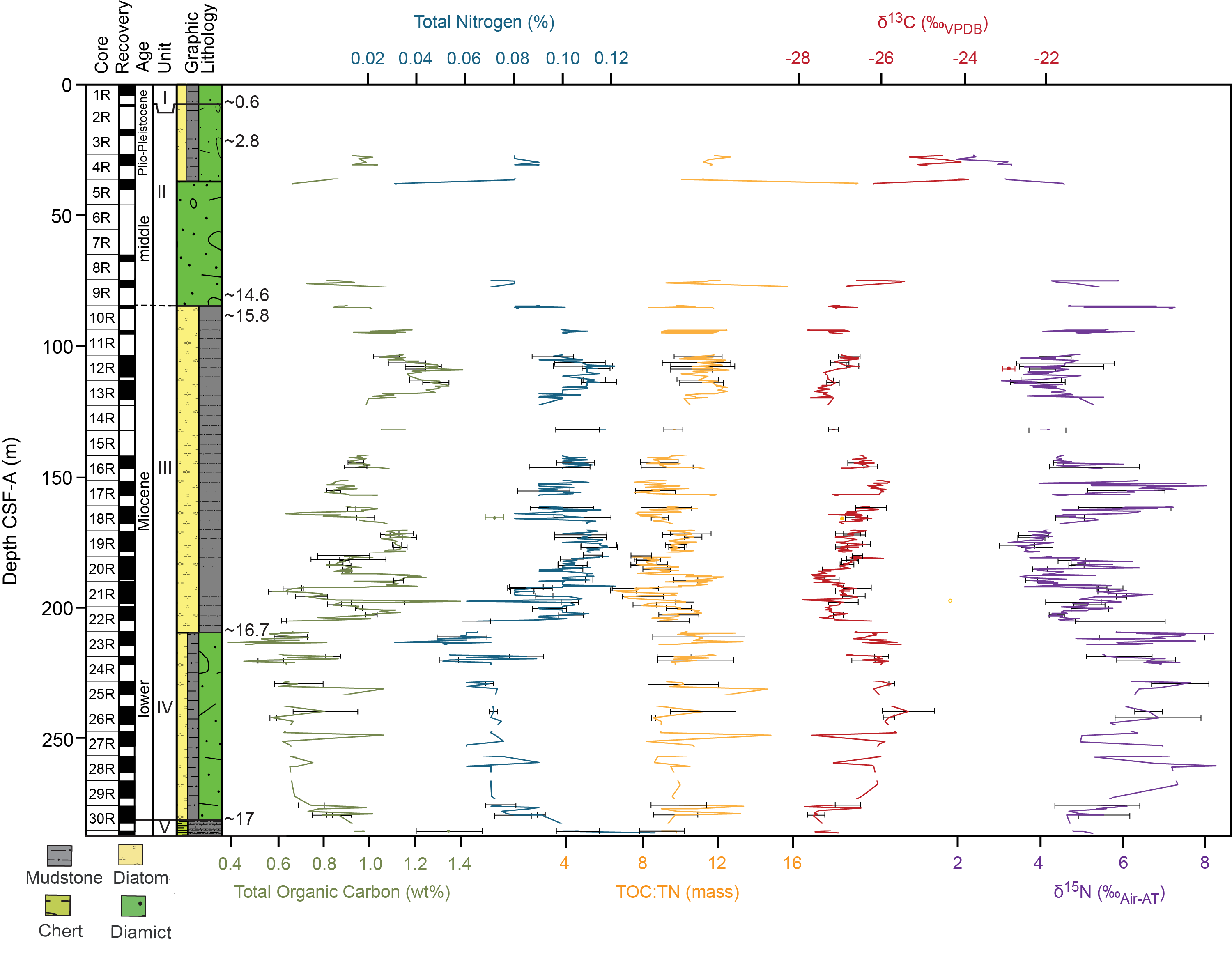
Figure F2. %TOC, %TN, TOC/TN mass ratio, δ13Corg, and δ15N.
3. Results
Site U1521 TOC, TN, TOC/TN, δ13Corg, and δ15N data are plotted against depth (CSF-A depth scale) with the shipboard lithostratigraphy (Figure F2; Table T2; see Supplementary data). TOC content ranges 0.39–1.55 wt% (average = 0.95 ± 0.2 wt%) with lower values in the diamictites of Units II and IV and slightly higher values in the diatom-bearing/-rich mudstones and diatomites of Unit III. TN content is low, ranging 0.03–0.14 wt% (average = 0.10 ± 0.02 wt%), and covaries with TOC. TOC/TN ratios range 6.60–24.60 (average = 10.18) and are variable throughout, increasing slightly from the top of Unit III into Unit II. The observed TOC/TN range is typical of Southern Ocean marine phytoplankton, although ratios ≥13 may indicate terrestrially derived organic matter presence (Prahl et al., 1980; Lamb et al., 2006; Smith et al., 2019).
Shipboard measurements taken during Expedition 374 range 0.11–1.20 wt% (n = 73; average = 0.61 ± 0.29 wt%) for TOC and 0.013–0.101 wt% (n = 82; average = 0.056 ± 0.02 wt%) for TN. These results are in general agreement with the data reported here, except for one outlier (TOC = 7.02; 345.27 m CSF-A), which was excluded from the calculated averages (McKay et al., 2019b).
δ13Corg ranges −28.10‰ to −22.90‰ (average = −26.80‰ ± 0.67‰), typical of Southern Ocean phytoplankton (Lourey et al., 2004; Lin et al., 2023) and Antarctic glaciomarine sediments (Smith et al., 2019). Generally, δ13Corg is more negative in Units V, IV, and III and more positive in Unit II. δ15N ranges 1.97‰–8.25‰ (average = 5.05‰ ± 1.19‰), and values are more positive in Unit IV, more negative and variable in Unit III, and most negative in Unit II.
4. Summary
Bulk sediment organic geochemical records from Site U1521 (McKay et al., 2019b) indicate downhole changes in %TOC, %TN, TOC/TN (mass), δ13Corg, and δ15N that coincide with changes in lithology. In general, %TOC, δ13Corg, and %TN are lower in diamictites and higher in diatom-bearing/rich mudstones, whereas TOC/TN and δ15N are highest in diamictites and lower in diatom-bearing/rich mudstones. Within lithostratigraphic units (e.g., Unit III), finer scale variability is observed across all records. Results indicate that organic matter sources (e.g., terrigenous and marine) varied as ice sheets advanced and retreated across the Ross Sea shelf.
5. Supplementary data
Supplementary data are archived on Zenodo (https://doi.org/10.5281/zenodo.17298585).
6. Acknowledgments
This study used samples provided by the International Ocean Discovery Program (IODP) and was supported by US Science Support Program (USSSP) postexpedition funding and National Science Foundation (NSF) OPP ANT 1947646 to A.E. Shevenell and USSSP postexpedition funding and NSF OPP ANT 1947657 to J. Dodd. We thank Denise Kulhanek and Charlotte Hipkiss for their helpful reviews.
References
Balint, S., Schwartz, M., Fowler, D.N., Linnekogel, S., Clemons, S.C., and Burkemper, L.K., 2024. Experimental assessment of elemental analyzer isotope ratio mass spectrometry normalization methodologies for environmental stable isotopes. Rapid Communications in Mass Spectrometry, 38(17):e9837. https://doi.org/10.1002/rcm.9837
Brodie, C.R., Leng, M.J., Casford, J.S.L., Kendrick, C.P., Lloyd, J.M., Yongqiang, Z., and Bird, M.I., 2011. Evidence for bias in C and N concentrations and δ13C composition of terrestrial and aquatic organic materials due to pre-analysis acid preparation methods. Chemical Geology, 282(3):67–83. https://doi.org/10.1016/j.chemgeo.2011.01.007
Coplen, T.B., 2011. Guidelines and recommended terms for expression of stable-isotope-ratio and gas-ratio measurement results. Rapid Communications in Mass Spectrometry, 25(17):2538–2560. https://doi.org/10.1002/rcm.5129
Coplen, T.B., Brand, W.A., Gehre, M., Gröning, M., Meijer, H.A.J., Toman, B., and Verkouteren, R.M., 2006. New guidelines for δ13C measurements. Analytical Chemistry, 78(7):2439–2441. https://doi.org/10.1021/ac052027c
Lamb, A.L., Wilson, G.P., and Leng, M.J., 2006. A review of coastal palaeoclimate and relative sea-level reconstructions using δ13C and C/N ratios in organic material. Earth-Science Reviews, 75(1):29–57.
https://doi.org/10.1016/j.earscirev.2005.10.003
Lin, Y., Li, Y., Huang, Y., Chen, Z., Wang, L., Li, D., and Tao, S., 2023. Suspended particulate organic carbon and its carbon isotopic composition in the surface water around the Antarctic Peninsula during summer 2017–2018. Antarctic Science, 35(3):194–208. https://doi.org/10.1017/S0954102023000093
Lourey, M.J., Trull, T.W., and Tilbrook, B., 2004. Sensitivity of δ13C of Southern Ocean suspended and sinking organic matter to temperature, nutrient utilization, and atmospheric CO2. Deep Sea Research Part I: Oceanographic Research Papers, 51(2):281–305. https://doi.org/10.1016/j.dsr.2003.10.002
McKay, R., Cockrell, J., Shevenell, A.E., Laberg, J.S., Burns, J., Patterson, M., Kim, S., Naish, T., Harwood, D., Levy, R., Marschalek, J., van de Flierdt, T., Ishino, S., Keisling, B., Sousa, I.M.C.d., Cortese, G., Sangiorgi, F., Leckie, R.M., Dodd, J., Duncan, B., Pérez, L.F., Romans, B.W., Kim, S., Bombard, S., Browne, I., van Peer, T., Seki, O., Colleoni, F., Kulhanek, D., De Santis, L., and the IODP Expedition 374 Science Team, 2024. Miocene ice sheet dynamics and sediment deposition in the central Ross Sea, Antarctica. Geological Society of America Bulletin, 137(3–4):1267–1291. https://doi.org/10.1130/B37613.1
McKay, R.M., De Santis, L., Kulhanek, D.K., Ash, J.L., Beny, F., Browne, I.M., Cortese, G., Cordeiro de Sousa, I.M., Dodd, J.P., Esper, O.M., Gales, J.A., Harwood, D.M., Ishino, S., Keisling, B.A., Kim, S., Kim, S., Laberg, J.S., Leckie, R.M., Müller, J., Patterson, M.O., Romans, B.W., Romero, O.E., Sangiorgi, F., Seki, O., Shevenell, A.E., Singh, S.M., Sugisaki, S.T., van de Flierdt, T., van Peer, T.E., Xiao, W., and Xiong, Z., 2019a. Expedition 374 summary. In McKay, R.M., De Santis, L., Kulhanek, D.K., and the Expedition 374 Scientists, Ross Sea West Antarctic Ice Sheet History. Proceedings of the International Ocean Discovery Program, 374: College Station, TX (International Ocean Discovery Program). https://doi.org/10.14379/iodp.proc.374.101.2019
McKay, R.M., De Santis, L., Kulhanek, D.K., Ash, J.L., Beny, F., Browne, I.M., Cortese, G., Cordeiro de Sousa, I.M., Dodd, J.P., Esper, O.M., Gales, J.A., Harwood, D.M., Ishino, S., Keisling, B.A., Kim, S., Kim, S., Laberg, J.S., Leckie, R.M., Müller, J., Patterson, M.O., Romans, B.W., Romero, O.E., Sangiorgi, F., Seki, O., Shevenell, A.E., Singh, S.M., Sugisaki, S.T., van de Flierdt, T., van Peer, T.E., Xiao, W., and Xiong, Z., 2019b. Site U1521. In McKay, R.M., De Santis, L., Kulhanek, D.K., and the Expedition 374 Scientists, Ross Sea West Antarctic Ice Sheet History. Proceedings of the International Ocean Discovery Program, 374: College Station, TX (International Ocean Discovery Program). https://doi.org/10.14379/iodp.proc.374.103.2019
Pérez, L.F., De Santis, L., McKay, R.M., Larter, R.D., Ash, J., Bart, P.J., Böhm, G., Brancatelli, G., Browne, I., Colleoni, F., Dodd, J.P., Geletti, R., Harwood, D.M., Kuhn, G., Sverre Laberg, J., Leckie, R.M., Levy, R.H., Marschalek, J., Mateo, Z., Naish, T.R., Sangiorgi, F., Shevenell, A.E., Sorlien, C.C., van de Flierdt, T., and the International Ocean Discovery Program Expedition 374 Scientists, 2022. Early and middle Miocene ice sheet dynamics in the Ross Sea: results from integrated core-log-seismic interpretation. Geological Society of America Bulletin, 134(1–2):348–370. https://doi.org/10.1130/B35814.1
Prahl, F.G., Bennett, J.T., and Carpenter, R., 1980. The early diagenesis of aliphatic hydrocarbons and organic matter in sedimentary particulates from Dabob Bay, Washington. Geochimica et Cosmochimica Acta, 44(12):1967–1976. https://doi.org/10.1016/0016-7037(80)90196-9
Qi, H., Coplen, T.B., Geilmann, H., Brand, W.A., and Böhlke, J.K., 2003. Two new organic reference materials for δ13C and δ15N measurements and a new value for the δ13C of NBS 22 oil. Rapid Communications in Mass Spectrometry, 17(22):2483–2487. https://doi.org/10.1002/rcm.1219
Qi, H., Coplen, T.B., Mroczkowski, S.J., Brand, W.A., Brandes, L., Geilmann, H., and Schimmelmann, A., 2016. A new organic reference material, l-glutamic acid, USGS41a, for δ13C and δ15N measurements − a replacement for USGS41. Rapid Communications in Mass Spectrometry, 30(7):859–866. https://doi.org/10.1002/rcm.7510
Schimmelmann, A., Albertino, A., Sauer, P.E., Qi, H., Molinie, R., and Mesnard, F., 2009. Nicotine, acetanilide and urea multi-level 2H-, 13C- and 15N-abundance reference materials for continuous-flow isotope ratio mass spectrometry. Rapid Communications in Mass Spectrometry, 23(22):3513–3521. https://doi.org/10.1002/rcm.4277
Smith, J.A., Graham, A.G.C., Post, A.L., Hillenbrand, C.-D., Bart, P.J., and Powell, R.D., 2019. The marine geological imprint of Antarctic ice shelves. Nature Communications, 10(1):5635.
https://doi.org/10.1038/s41467-019-13496-5
Werner, R.A., and Brand, W.A., 2001. Referencing strategies and techniques in stable isotope ratio analysis. Rapid Communications in Mass Spectrometry, 15(7):501–519. https://doi.org/10.1002/rcm.258
Werner, R.A., Bruch, B.A., and Brand, W.A., 1999. ConFlo III – an interface for high precision δ13C and δ15N analysis with an extended dynamic range. Rapid Communications in Mass Spectrometry, 13(13):1237–1241. https://doi.org/10.1002/(SICI)1097-0231(19990715)13:13<1237::AID-RCM633>3.0.CO;2-C