Druitt, T.H., Kutterolf, S., Ronge, T.A., and the Expedition 398 Scientists
Proceedings of the International Ocean Discovery Program Volume 398
publications.iodp.org
https://doi.org/10.14379/iodp.proc.398.206.2026
Data report: marine tephra inventory and glass compositions of tephra layers younger than 765 ka (IODP Expedition 398)1
Katharina Pank,2 Steffen Kutterolf,2 Abigail Metcalfe,3 Timothy H. Druitt,2 Carole Berthod,2 Acacia Clark,2 Susan DeBari,2 Ralf Gertisser,2 Ally Peccia,2 Thomas A. Ronge,2 Sarah Beethe,2 Alexis Bernard,2 Hehe Chen,2 Shun Chiyonobu,2 Christian Hübscher,2 Raymond M. Johnston,2 Christopher Jones,2 K. Batuk Joshi,2 Gunther Kletetschka,2 Olga Koukousioura,2 Xiaohui Li,2 Michael Manga,2 Molly McCanta,2 Iona McIntosh,2 Antony Morris,2 Paraskevi Nomikou,2 Tatiana I. Fernandez Perez,2 Paraskevi N. Polymenakou,2 Jonas Preine,2 Masako Tominaga,2 Adam Woodhouse,2 Yuzuru Yamamoto,2 Janne M. Scheffler,4 Kuo-Lung Wang,5, 6 Hao-Yang Lee,5 and Axel K. Schmitt7
1 Pank, K., Kutterolf, S., Metcalfe, A., Druitt, T.H., Berthod, C., Clark, A., DeBari, S., Gertisser, R., Peccia, A., Ronge, T.A., Beethe, S., Bernard, A., Chen, H., Chiyonobu, S., Hübscher, C., Johnston, R.M., Jones, C., Joshi, K.B., Kletetschka, G., Koukousioura, O., Li, X., Manga, M., McCanta, M., McIntosh, I., Morris, A., Nomikou, P., Fernandez Perez, T.I., Polymenakou, P.N., Preine, J., Tominaga, M., Woodhouse, A., Yamamoto, Y., Scheffler, J.M., Wang, K.-L., Lee, H.-Y., and Schmitt, A.K., 2026. Data report: marine tephra inventory and glass compositions of tephra layers younger than 765 ka (IODP Expedition 398). In Druitt, T.H., Kutterolf, S., Ronge, T.A., and the Expedition 398 Scientists, Hellenic Arc Volcanic Field. Proceedings of the International Ocean Discovery Program, 398: College Station, TX (International Ocean Discovery Program). https://doi.org/10.14379/iodp.proc.398.206.2026
2 Expedition 398 Scientists’ affiliations. Correspondence author: [email protected]
3 University Clermont-Auvergne, CNRS, IRD, OPGC, Laboratoire Magmas et Volcans, France. Also at School of Earth Sciences, University of Bristol, United Kingdom.
4 GEOMAR Helmholtz Centre for Ocean Research Kiel, Germany.
5 Institute of Earth Sciences, Academia Sinica, Taiwan.
6 Department of Geosciences, National Taiwan University, Taiwan.
7 John de Laeter Centre, Curtin University, Australia. Also at Institut für Geowissenschaften, Universität Heidelberg, Heidelberg, Germany.
Abstract
Marine sediments preserve long and mostly undisturbed archives of past (explosive) volcanic activity in the form of tephra layers and are therefore an important complement to volcanic onshore records, which are often limited in time and/or incomplete because of erosion and burial. International Ocean Discovery Program (IODP) Expedition 398 drilled the marine basins of the Christiana-Santorini-Kolumbo volcanic field (Greece) to overcome this problem, investigate the early history of this volcanic field, and groundtruth published seismic stratigraphy. The expedition recovered more than 3 km of marine sediments, of which ~1.1 km consist of layers containing >75 vol% of volcanic components.
Here, we report on the marine tephra inventories younger than 765 ka (age of the Archaeos Tuff) from Expedition 398 Sites U1591, U1598, U1599, and U1600 (total of 909 samples), complemented by the already published marine tephra inventories of Sites U1589, U1590, U1592, and U1593 (total of 414 samples). We provide the major and trace element compositions of a total of 1,323 marine volcanic samples: 15,852 single glass shard analyses by electron microprobe for major element compositions and 4,443 single analyses by laser ablation–inductively coupled plasma–mass spectrometry for trace element compositions. Of all the samples, about 1060 can be classified as tephra usually containing >90 vol% of vitric volcanic components in the 63–125 µm grain size fraction. The compositions of tephra layers younger than 765 ka range from basalt to rhyolite as well as minor trachyte. They are divided between the calc-alkaline and high-K calc-alkaline magmatic series with some excursions into the shoshonitic magmatic series. Compositional discrimination based on major and trace element compositions and ratios enable us to distinguish compositional groups, mainly following the known compositions of Modern and Ancient Santorini, but also revealing new compositional groups. These compositional variations will be investigated in future studies.
1. Introduction
International Ocean Discovery Program (IODP) Expedition 398 drilled the marine sediments of the Christiana-Santorini-Kolumbo volcanic field (CSKVF) on the south Aegean volcanic arc (Greece). Santorini’s latest eruptive history is well constrained (Thera Pyroclastic Formation [TPF]) (Druitt et al., 1999), mainly based on the onshore volcanic record, but the volcanic histories of early Santorini and neighboring volcanoes Christiana and Kolumbo were less well constrained prior to the expedition because of the paucity of onshore volcanic deposits. Expedition 398 aimed to (1) investigate the volcanic evolution of the central south Aegean volcanic arc; (2) identify and document potential links between volcanism, tectonics, and climate (e.g., sea level); (3) investigate the processes and products of shallow submarine eruptions; and (4) groundtruth interpretations of the seismic stratigraphy of Santorini caldera and surrounding basins (Druitt et al., 2024a).
A total of 12 sites were drilled during Expedition 398 (Druitt et al., 2024a). Eight drill sites targeted the marine sediments of the CSKVF basins. Expedition 398 Sites U1589 (Holes U1589A–U1589C), U1590 (Holes U1590A and U1590B), and U1593 (Holes U1593A–U1593C) are located in the Anhydros Basin; Sites U1592 (Holes U1592A and U1592B) and U1599 (Holes U1599A–U1599C) are located in the Anafi Basin; Site U1600 (Holes U1600A–U1600C) is located on the ridge separating the Anhydros and Anafi Basins (i.e., Anhydros Ridge); and Sites U1591 (Holes U1591A–U1591C) and U1598 (Holes U1598A and U1598B) are located in the Christiana Basin (Figure F1). Sites U1589, U1591–U1593, and U1598–U1600 provide continuous marine sediment successions enabling groundtruthing of the previously established seismic stratigraphy (e.g., Preine et al., 2022; Preine et al., 2025); investigate volcano-tectonic, volcano-climate, and potentially sea level interactions; and complement and extend our knowledge of CSKVF volcanism. Sites U1590 and U1593 are located close to submarine Kolumbo, targeting its eruptive units shown in seismic profiles (Druitt et al., 2022; Metcalfe et al., 2026; Preine et al., 2026). In addition, four sites inside Santorini caldera (Sites U1594–U1597; not shown in Figure F1) were drilled to recover the post-Minoan eruption (3.6 ka) intracaldera sediments and constrain the volcanic evolution of the intracaldera Kameni Volcano.
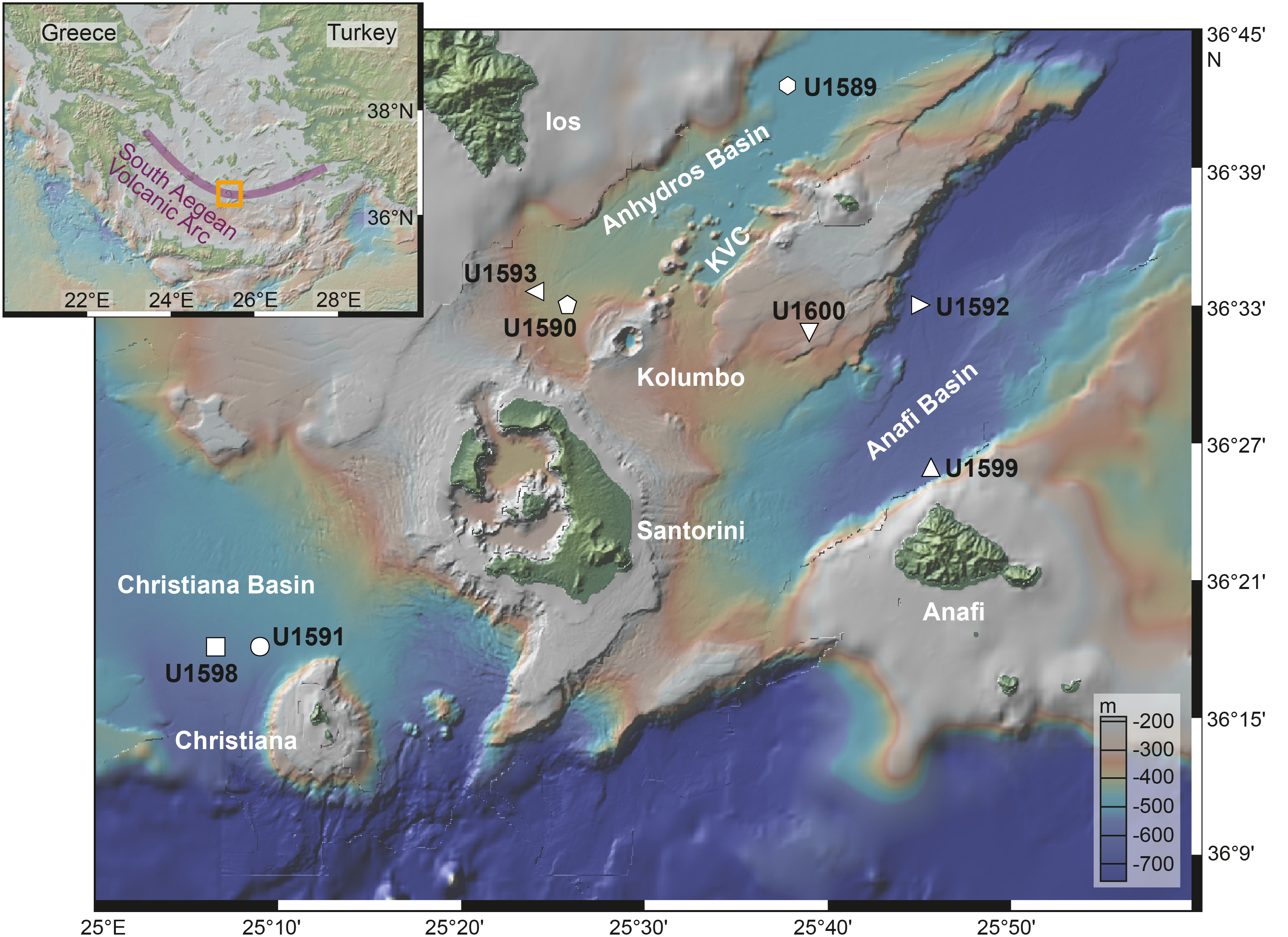
Figure F1. Bathymetric map.
A key discovery of Expedition 398 was a 150 m thick volcanic deposit in the marine basins around Santorini, the Archaeos Tuff (AT) (Druitt et al., 2024g). The AT is interpreted to be the result of a shallow submarine caldera-forming eruption dated at ~765 ka (Beethe et al., 2025), and it forms an excellent marker bed in the marine sediments. Thickness and grain size distribution, combined with seismic mapping of the volcanic unit within the CSKVF, imply that its volcanic source may lie buried below or close to present-day Santorini. The unique composition of the AT represents a new compositional end-member of Santorini’s early volcanic activity that was not known before (Druitt et al., 2024g).
In this report, we focus on the marine tephra inventory stratigraphically overlying the Archaeos Tuff (i.e., <765 ka) (Table T1; Figure F2). We present the compositional data (major and trace element compositions of glass shards) for Sites U1599 and U1600 (Anafi Basin and Anhydros Ridge) and U1591 and U1598 (Christiana Basin), complemented by the already published tephra inventory of the Anhydros Basin (Sites U1589, U1590, and U1593) and Site U1592 (Anafi Basin) (Metcalfe et al., 2025a, 2025b, 2026) (Figures F3, F4).
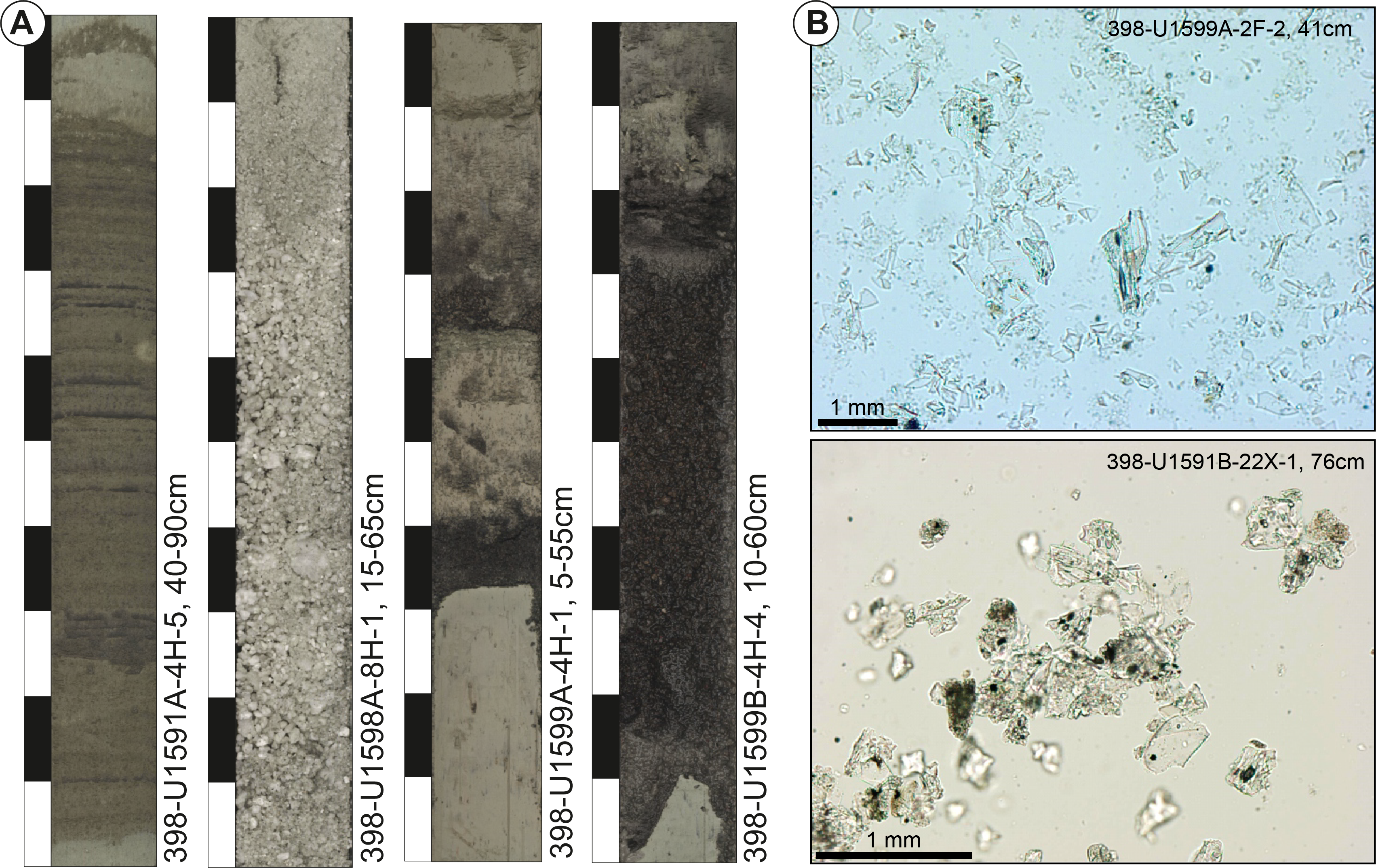
Figure F2. Marine tephra layers.
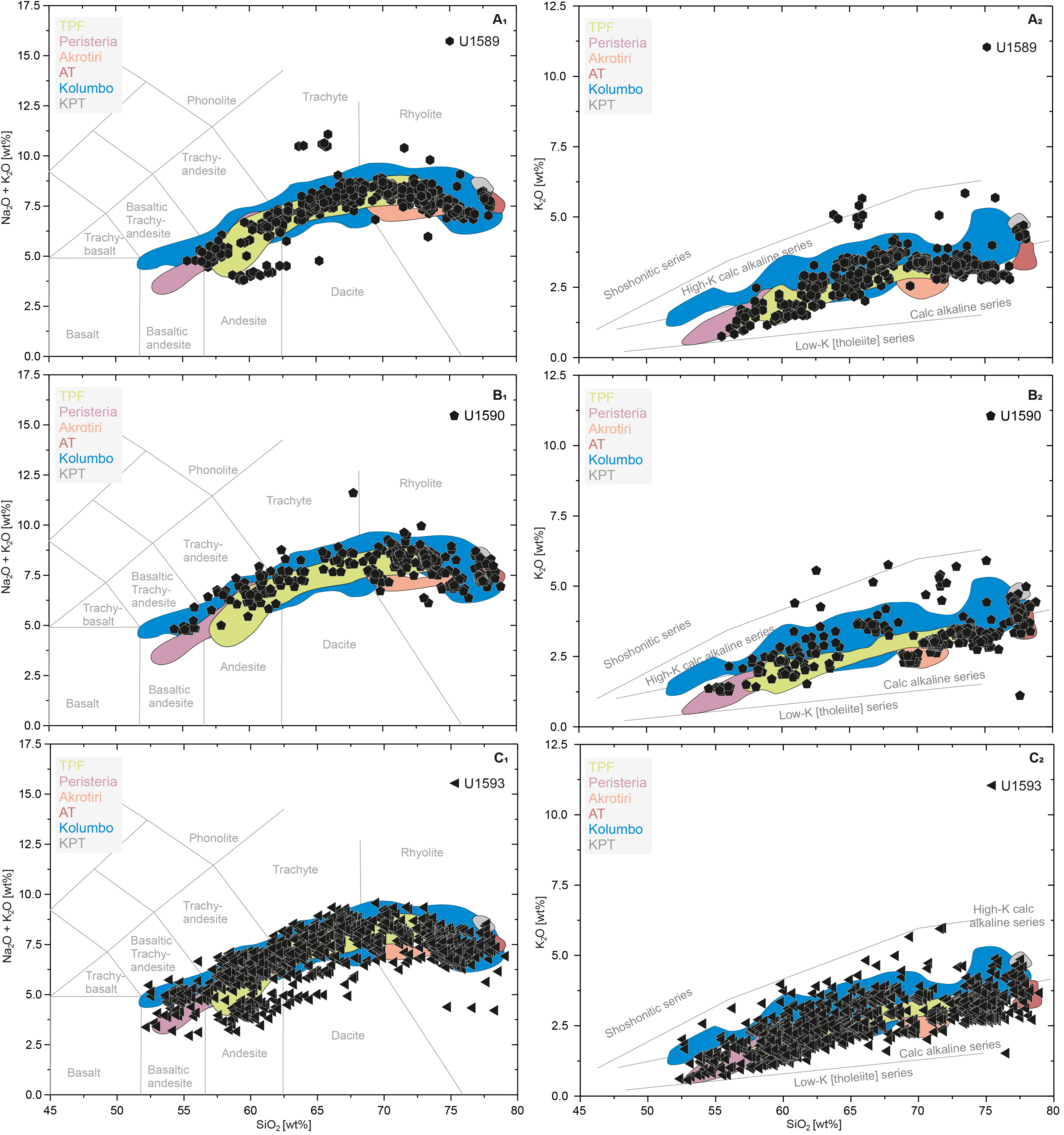
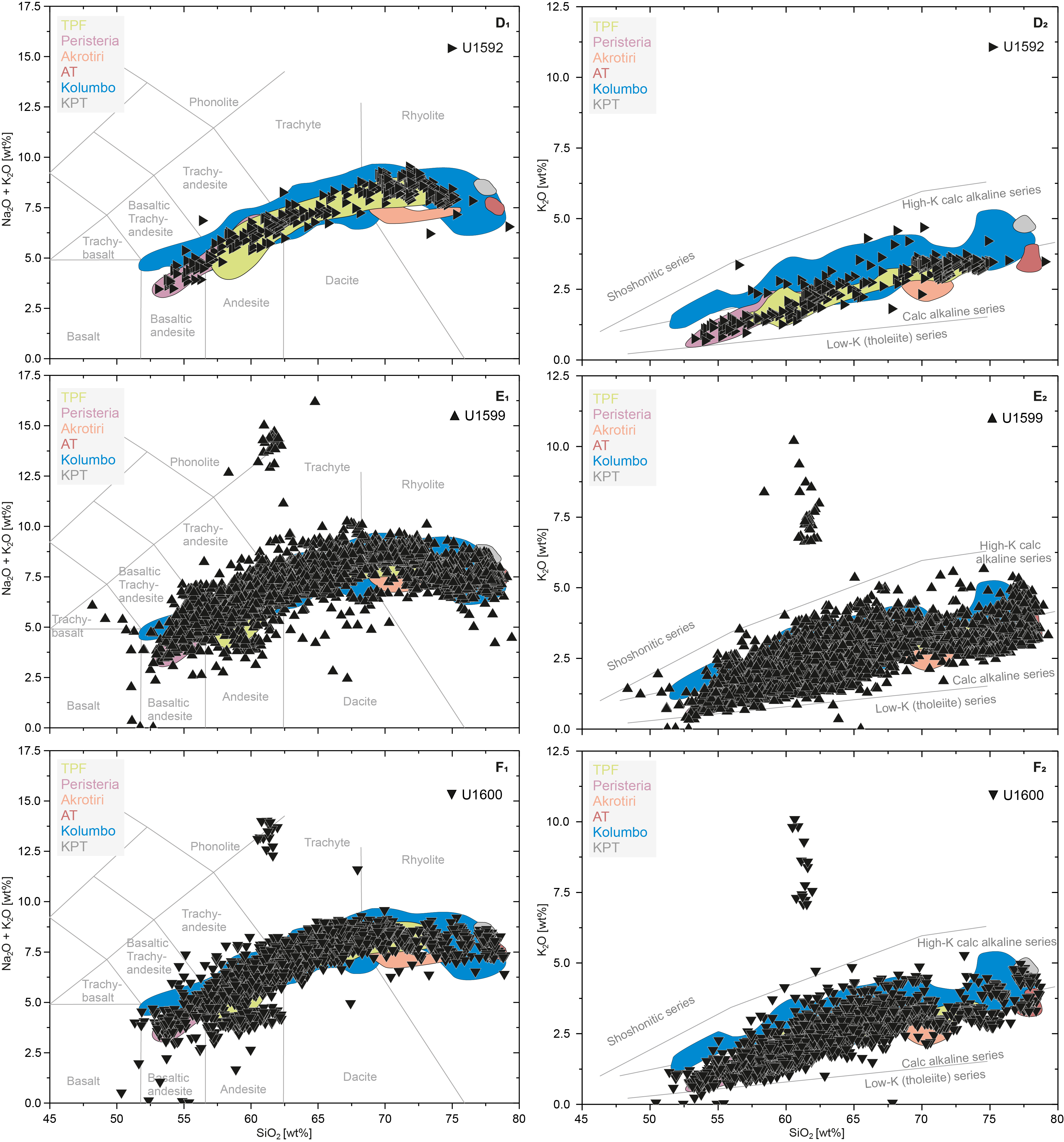
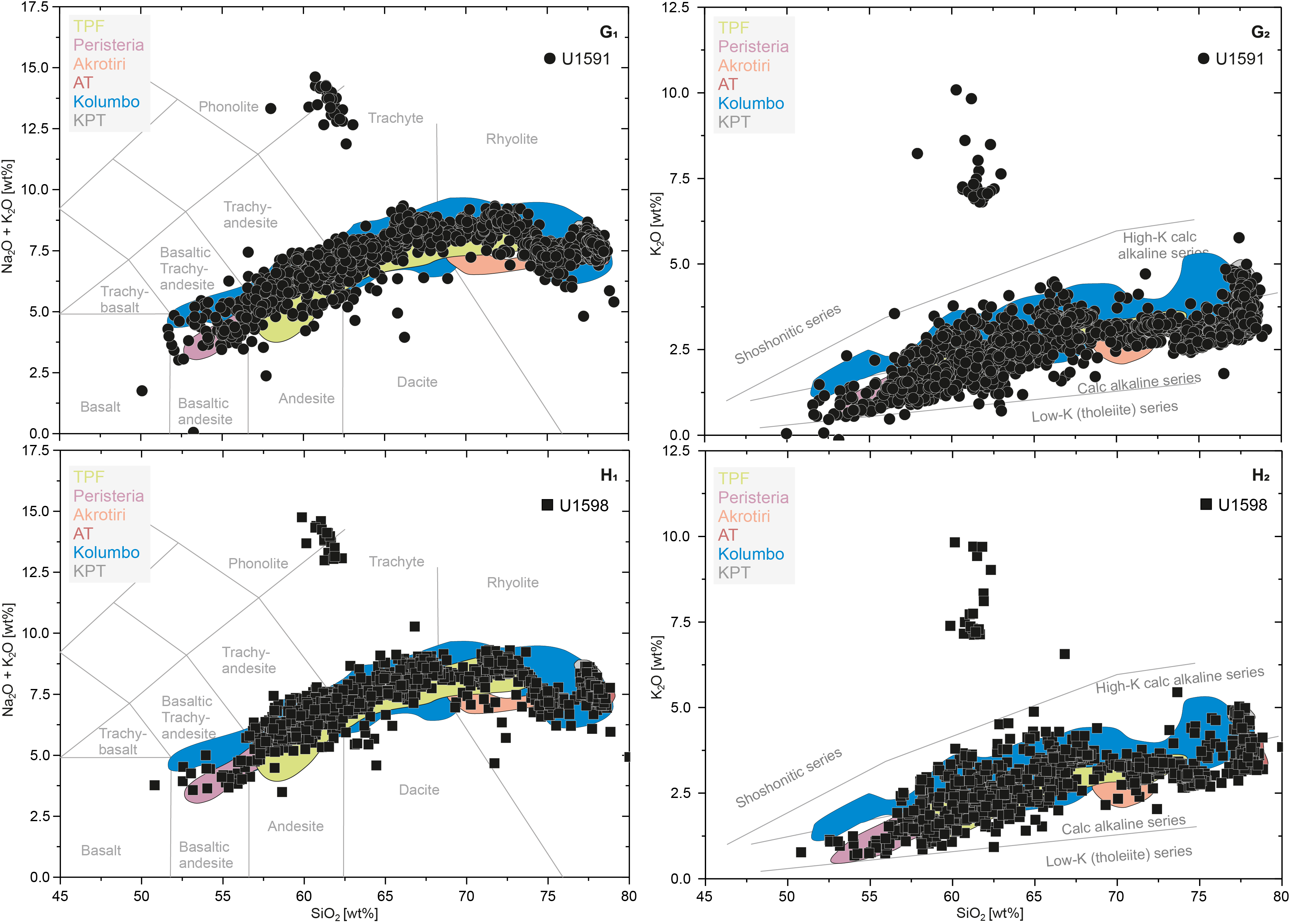
Figure F3. Individual glass shard analyses.
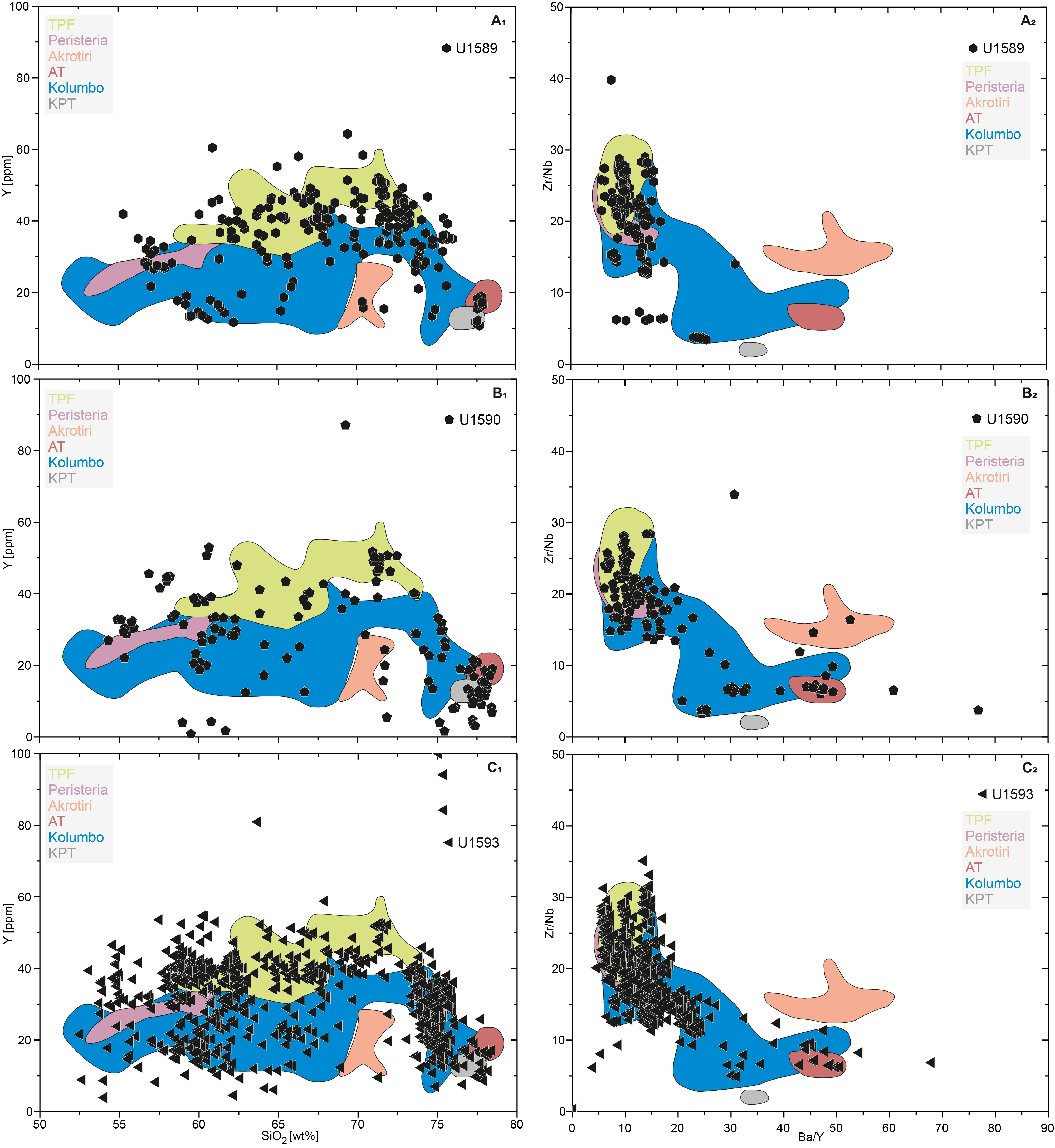
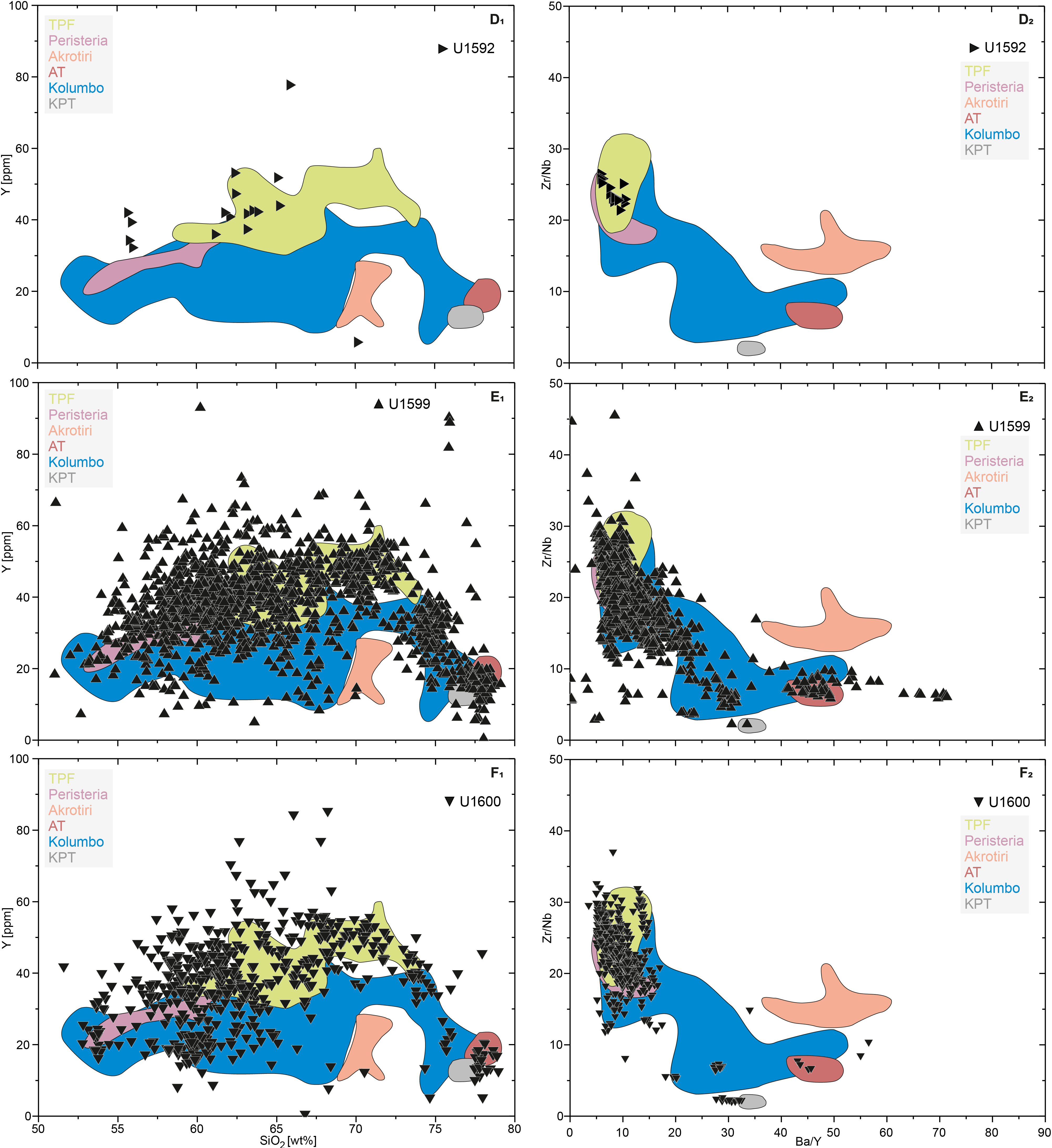
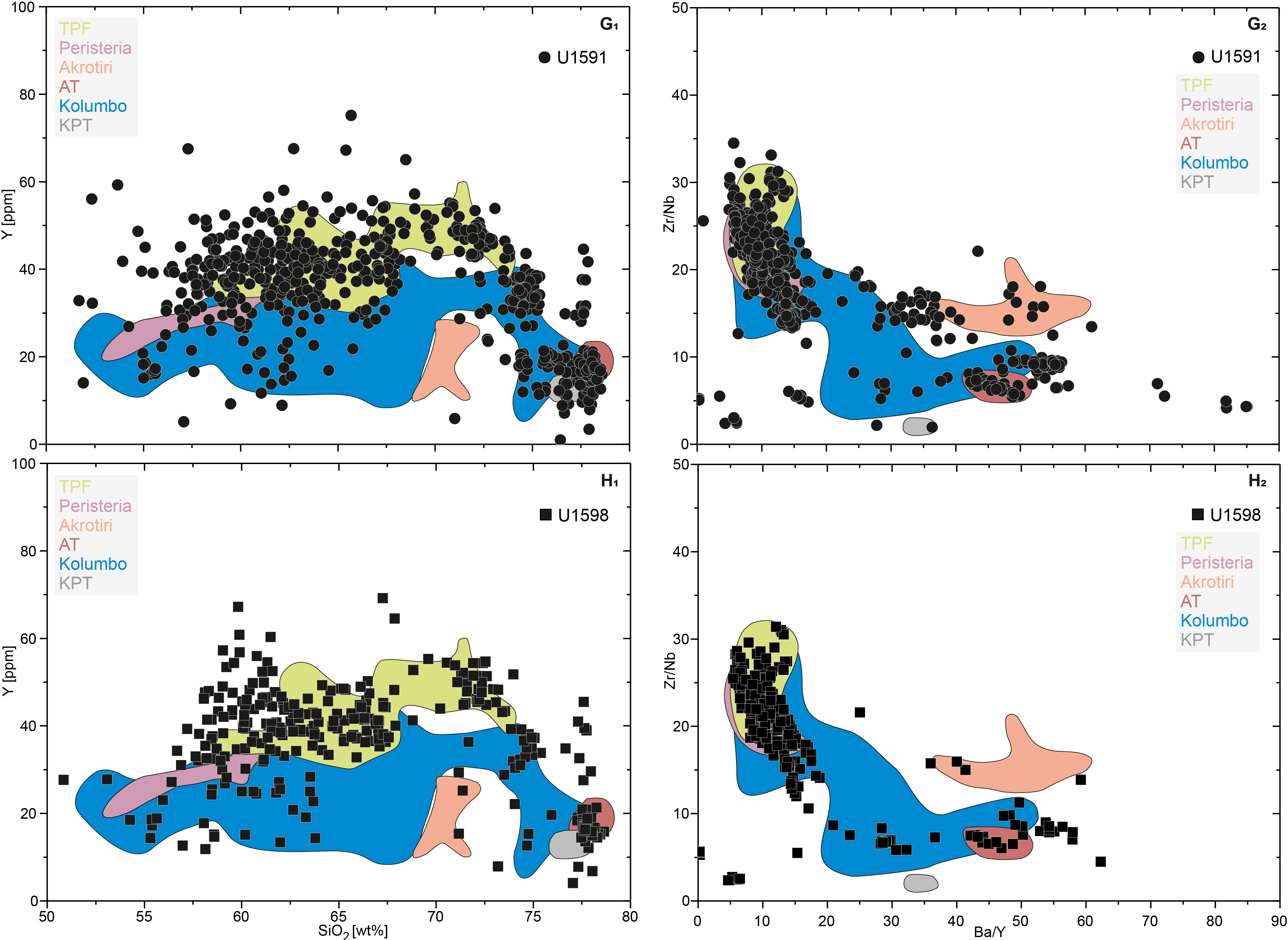
Figure F4. Compositional variability of tephra inventories.
1.1. Geologic overview
Volcanism along the south Aegean volcanic arc is associated with the subduction of the African plate beneath the Aegean microplate. Back-arc extension led to a thinned continental crust, forming horsts and grabens (Le Pichon and Kreemer, 2010; Royden and Papanikolaou, 2011). The arc hosts five volcanic fields, of which the CSKVF is the centralmost and southernmost along the arc (Figure F1). The CSKVF consists of three polygenetic volcanic centers (Christiana, Santorini, and Kolumbo) and a linear chain of 24 submarine cones, the Kolumbo volcanic chain (KVC) northeast of Kolumbo (Preine et al., 2022). The CSKVF is in a 100 km long and 45 km wide northeast–southwest oriented rift zone with three main marine basins, including the Anhydros and Anafi Basins relevant to the present report (Druitt et al., 2024b and references therein).
Of the three polygenetic volcanic edifices of the CSKVF, Santorini is by far the best-studied, mainly based on onland studies (Druitt et al., 1999) increasingly complemented by shallow marine coring campaigns (e.g., Wulf et al., 2020; Kutterolf et al., 2021). The onland studies show that Santorini’s volcanic activity began at least at 650 ka with submarine and then subaerial effusive volcanism. It can be grouped into Ancient (older than 650–550 ka) and Modern (younger than 550 ka) Santorini based on a compositional change at ~550 ka from predominantly amphibole-bearing rhyolites and rhyodacites (Ancient Santorini) to amphibole-scarce basalts to rhyodacites (Modern Santorini) (Druitt et al., 1999). Since ~360 ka, volcanism forming the TPF is described as highly explosive, comprising at least 12 Plinian eruptions and ~100 less intense explosive eruptions (called Interplinian eruptions) (Druitt et al., 1999). The Minoan eruption at 3.6 ka is the youngest caldera-forming eruption at Santorini. Since then, continued activity has formed the Kameni Volcano in the present-day caldera of Santorini.
However, the first postexpedition studies of Expedition 398 shed new light onto Santorini’s volcanic evolution:
- The discovery of the AT (~765 ka) indicates that Ancient Santorini was not only already active at that time but was capable of highly explosive eruptions (Druitt et al., 2024g).
- The onset of the highly explosive period of Santorini that formed the TPF took place at ~250 ka (Metcalfe et al., 2025a), not at ~360 ka as implied by previous studies (Druitt et al., 1999; Vakhrameeva et al., 2018; Wulf et al., 2020).
- The intracaldera Kameni Volcano produced a ~1 km3 (dense-rock equivalent) explosive eruption in 726 Common Era (CE) (Preine et al., 2024), showing that explosive volcanism of moderate magnitude remains a characteristic of this volcanic system and accompanies effusive eruptions.
- The earliest tephra with Ancient Santorini chemistry found in the Anhydros and Anafi Basins has an age of ~940 ka (Metcalfe et al., 2026), older than the earliest volcanic deposits on land and the AT.
Kolumbo is a submarine volcanic edifice located northeast of Santorini, with a chain of more than 24 submarine volcanic cones (KVCs) extending toward the northeast (e.g., Nomikou et al., 2012; Preine et al., 2022). Seismic profiles across Kolumbo reveal five volcanic edifices (Hübscher et al., 2015), with the youngest formed during the well-studied 1650 CE eruption (Cantner et al., 2014), and four older buried edifices. Recent studies have sought to constrain the volcanic history of Kolumbo through dredge campaigns of the crater walls (Vougioukalakis et al., 2025). However, the coring depths and recovery of Expedition 398 (Druitt et al., 2024a) provide the most complete record of Kolumbo’s volcanic history to date (Metcalfe et al., 2026):
- The start of Kolumbo’s volcanic activity coincided with the transition of Santorini volcanism to the TPF period at ~250 ka.
- The marine sediments preserved the deposits of 19 explosive eruptions sourced from Kolumbo and the KVC. These range compositionally from basaltic andesite to rhyolite (Figures F3, F4).
Christiana Volcano is probably the oldest volcanic edifice of the CSKVF and consists mainly of lavas. Onland lavas were dated using 40Ar/39Ar, revealing that Christiana was active at about 2.7–2.5 Ma (Vroon et al., 2026); however, its volcanic evolution is overall poorly constrained, and seismic data imply that volcanic activity ceased at about 1.6 Ma (Preine et al., 2022).
1.2. Overview of expedition drill sites
Expedition 398 Site U1589 is located in the Anhydros Basin at 494 meters below sea level (mbsl) (Figure F1) and aimed to recover continuous marine sediments to enable the reconstruction of the evolution of the Anhydros Basin. Drilling in the three holes (U1589A–U1589C) was successful with good recovery (Table T1) (Druitt et al., 2024c), and the marine sediments at Site U1589 were divided into five lithostratigraphic units. The AT was drilled between ~300 and 308 meters below seafloor (mbsf) in Holes U1589A and U1589B (Druitt et al., 2024g; Druitt et al., 2024c) and represents lithostratigraphic Unit II. The uppermost Unit I, which stratigraphically overlies Unit II (Holes U1589A and U1589B), is described as predominantly sedimentary, dominated by volcaniclastics (ash, lapilli, lapilli-ash, and tuffaceous mud).
Expedition 398 Site U1590 is located on the southern flank of the Anhydros Basin at 397 mbsl (Figure F1) (Kutterolf et al., 2024b) and was drilled to recover seismically recognized eruptive units of Kolumbo. Two holes were drilled at Site U1590 (Holes U1590A and U1590B), and core recovery was moderate to poor (Table T1). Two lithostratigraphic units were identified at Site U1590: a predominantly volcanic Unit I (Hole U1590A) and an ooze-dominated Unit II with tuffaceous and minor volcanic intervals (Hole U1590B) (Kutterolf et al., 2024b). The AT was only recovered in a core catcher, and its thickness was constrained seismically (Metcalfe et al., 2026; Preine et al., 2026).
Expedition 398 Site U1591 is located in the Christiana Basin (Figure F1) at 514 mbsl and targeted the volcano-sedimentary infill of the deepest basin within the CSKVF (Figure F1), potentially recording the early volcanic activity of the CSKVF and neighboring volcanic fields along the south Aegean volcanic arc (e.g., Milos; Druitt et al., 2024d). Three holes were drilled (Holes U1591A–U1591C), and core recovery was good to moderate (Table T1). The marine sediments were grouped into three lithostratigraphic units. The AT was recovered between ~65 and 130 mbsf in Holes U1591A and U1591B (Druitt et al., 2024g), belongs to Unit I (uppermost ~152.8 m), and is described as a succession of tuffaceous muds and oozes and volcanic layers (ash and lapilli).
Expedition 398 Site U1592 is located in the Anafi Basin (Figure F1) at 693 mbsl (Kutterolf et al., 2024c). The aim at this site was to drill the entire volcano-sedimentary infill down to the basement to reconstruct the evolution of the Anafi Basin. Two holes were drilled at Site U1592 (Holes U1592A and U1592B), and core recovery was moderate to good (Table T1). The marine sediments were divided into five lithostratigraphic units, and the AT was recovered between ~350 and 400 mbsf in Hole U1592B (Unit II) (Druitt et al., 2024g). Unit I (Hole U1592A) is described as unconsolidated volcanic and tuffaceous lithologies, with minor ooze and organic-rich intervals, and Unit II is described as ooze dominated with subordinated volcanic material.
Expedition 398 Site U1593 is located at 402 mbsl in the Anhydros Basin (Figure F1). As for Site U1590, the aim of drilling Site U1593 was to recover the seismically defined eruptive units of Kolumbo. Three holes were drilled (Holes U1593A–U1593C) (Druitt et al., 2024e), and core recovery was only good in Holes U1593A and U1593B, whereas Hole U1593C gave very poor recovery (Table T1). The marine sediments were divided into two lithostratigraphic units, and the AT was recovered between ~115 and 190 mbsf in Holes U1593A and U1593B (Unit I) (Druitt et al., 2024g). Unit I was identified in Holes U1593A and U1593B and comprises predominantly volcanic and tuffaceous lithologies, with minor ooze and organic-rich intervals.
Expedition 398 Site U1598 was drilled in the Christiana Basin at 521.5 mbsl and, comparable to Site U1591, the volcano-sedimentary infill of the basin was targeted to recover the potentially longest record of volcanic history in the CSKVF and neighboring volcanic fields (Kutterolf et al., 2024d). Two holes were drilled, and core recovery was good (Hole U1598A) to poor (Hole U1598B) (Table T1). The marine sediments are unlithified in both holes and dominated by volcanic lithologies and lesser calcareous muds and ooze, summarized as Unit I. The AT was recovered between ~61 and >107 mbsf in both holes (Druitt et al., 2024g).
Expedition 398 Site U1599 is located in the southwestern Anafi Basin (Figure F1) at 592 mbsl. Although neighboring Site U1592 targeted the thick sedimentary infills of the Anafi Basin, the marine sediments at Site U1599 are more condensed and therefore potentially provide a more complete marine tephrostratigraphy from the CSKVF (Druitt et al., 2024f). Three holes (U1599A–U1599C) were drilled, and core recovery was moderate to good (Table T1). The marine sediments at Site U1599 are divided into four lithostratigraphic units, and the AT was recovered between ~150 and 182 mbsf (Unit I) (Table T1) (Druitt et al., 2024g). Unit I is dominated by volcanic and tuffaceous sediments with (organic-rich) ooze.
Expedition 398 Site U1600 is located atop the Anhydros Ridge, which separates the Anhydros Basin from the Anafi Basin at 326 mbsl (Figure F1) (Kutterolf et al., 2024e). Because of its location, Site U1600 is sheltered from large-scale mass wasting events and therefore provides a condensed sequence of background sediments and volcanic tephra. Three holes (U1600A–U1600C) were drilled, and core recovery was good to poor (Table T1). The marine sediments were grouped into three lithostratigraphic units, and the AT was recovered between ~37 and 43 mbsf (Unit I) (Table T1) (Druitt et al., 2024g). Unit I covers the uppermost ~74 mbsf and comprises volcanic and tuffaceous sediments, with occasional calcareous mud, bioclastic sand, and gravel with organic-rich varieties.
1.3. Marine tephra layers: macroscopic and microscopic description
Expedition 398 recovered a variety of marine volcanic deposits that were described shipboard. All data (physical, chemical, magnetic, etc.) collected during the expedition are provided in the IODP Laboratory Information Management System (LIMS) database. The accumulated thickness of recovered marine sediments from all basin drill sites younger than 765 ka is ~1070 m. Of these, ~860 m is described as discrete tephra layers, ash pods, and/or partly disrupted or bioturbated tephra layers.
The majority of recovered tephra layers range from several millimeters to several centimeters in thickness (Figure F2A). Massive tephra deposits of tens or even a few hundreds of meters were also recovered (Druitt et al., 2024g; Metcalfe et al., 2025b). Graded marine tephra layers are common; however, in some cases, drilling operations, core recovery, and core handling on deck may have influenced the grain size distribution of the marine tephra layers (Jutzeler et al., 2025). Such changes do not affect the data reported in this study. Grain size ranges from fine ash (<63 µm) to lapilli (2–64 mm) (Figure F2A), with rare blocks and bombs (>64 mm) (Kutterolf et al., 2024a). The color of the tephra deposits is variable: white, beige to white-pinkish, black, dark gray, and reddish black to brown.
The shipboard preparation of sediment smear slides enabled microscopic description (e.g., componentry, abundance, and morphology of vitric components) of selected tephra layers. Most tephra layers comprise predominantly transparent or brown volcanic glass (blocky, cuspate, and pumiceous; Figure F2B) with minor mineral components (e.g., biotite, amphiboles, or pyroxenes). Some tephra layers, however, are dominated by volcanic or plutonic lithics or minerals with little volcanic glass.
2. Methods
2.1. Sampling
The marine sediments were described shipboard for lithologic and sedimentary features as part of the shipboard visual core descriptions, including the first microscopic descriptions (smear slide petrography) of selected layers. Discrete tephra layers (>10 cm thick) were sampled during the expedition (pilot samples), and the sample material was distributed among shipboard scientists. About 6 months after the expedition (July 2023), the official sampling party for Expedition 398 took place at the Center for Marine Environmental Sciences (MARUM) Bremen Core Repository (BCR) (Germany), where tephra layers with a thickness >1 cm were sampled by all Expedition 398 scientists. In January 2024, a second sampling effort took place at the BCR, where discrete tephra layers of <1 cm thickness were sampled, complemented by sampling of missing layers from the previous sampling. Most samples were taken with the standard IODP plastic 10 cm3 scoops and tube containers; however, thin discrete tephra layers were cut out to avoid cross-contamination.
2.2. Sample preparation
The tephra samples were wet sieved into different grain size fractions (63–125, 125–250, >250 µm, and if necessary 32–63 µm) or crushed if needed and then wet sieved. The 63–125 and 125–250 µm fractions were further used for analyses of glass shards by embedding the fractions into a 1 inch predrilled acrylic mount (9–12 samples per mount) with the two-component epoxy resin araldite. The mounts were ground first to ensure a smooth sample surface and then polished using 9, 3, and 1 µm polish paste. The polished mounts were carbon coated to provide discharge of the electrons during the electron microprobe (EMP) measurements.
2.3. Electron microprobe analyses
The marine tephra inventory younger than 765 ka at Sites U1591, U1598, U1599, and U1600 comprises a total of 909 samples. Individual volcanic glass shards (10–20 shards per sample; n = 11,319) were analyzed for their major and minor element composition (Na2O, K2O, FeO, SiO2, TiO2, MgO, MnO, Al2O3, and P2O5) using a JEOL JXA 8200 wavelength dispersive EMP at the GEOMAR Helmholtz Centre for Ocean Research Kiel (Germany) using the methods of Kutterolf et al. (2011). An accelerating voltage of 15 kV, a beam current of 6 nA, and a 10 µm diameter electron beam to minimize sodium loss were used. Oxide concentrations were determined using the ZAF correction method. Accuracy was monitored by two measurements each on Lipari obsidian (Lipari rhyolite) (Hunt and Hill, 2001; Kuehn et al., 2011) and Smithsonian basaltic standard VGA99 (Makaopuhi Lava Lake, Hawaii) (Jarosewich et al., 1980) after ~80 single glass shard measurements. Repeated standard measurements on international standards revealed standard 1σ deviations of usually better than 3% except for TiO2, FeO, MgO, and P2O5 (Lipari) and usually better than 5% except for MnO and P2O5 (VGA99) (Supplementary Table S1 [see TABLES in Supplementary material]). Such analytical deviations can be caused by temporal variations (temperature, atmospheric pressure, etc.) over the runtime of the measurements (e.g., overnight or over the weekend), leading to minor changes in the z-axis of the electron focus. The data have been compiled during numerous sessions over the runtime of ~1.5 y, but the analyzed standard material data do not show systematic changes over time. All analyses with totals >90 wt% were normalized to 100 wt% to eliminate the effects of variable postdepositional hydration and the minor temporal deviations outlined above. Compositional outliers such as minerals (e.g., microlites) that were accidentally analyzed (e.g., Al2O3 > 20 wt%) and analyses with totals <90 wt% were excluded from the data set. Compositionally foreign glass shards, strongly deviating from the compositional mean of the sample’s analyses, were not included in the sample’s mean composition nor in the internal standard deviation (Supplementary Tables S6, S7, and S11–S16 [see TABLES in Supplementary material]).
For Sites U1589, U1590, U1592, and U1593 (Metcalfe et al., 2025a, 2025b, 2026), a total of 414 samples were prepared and analyzed for their major and minor element compositions (10–20 shards per sample; n = 4533; Supplementary Tables S3–S5 and S8–S10 [see TABLES in Supplementary material]) using a CAMECA SX-100 EMP at the Laboratory of Magmatism and Volcanism (Clermont-Ferrand, France). Instrument settings are identical at both institutes (see above and in Metcalfe et al. [2025a, 2025b, 2026]). The accuracy was monitored after every 20 single glass shard analyses. Further analytical details and standard measurements can be found in the respective publications. The data comparability of the instruments at GEOMAR Kiel (Germany) and at Laboratory of Magmatism and Volcanism (Clermont-Ferrand, France) is shown in Druitt et al. (2024g).
2.4. Laser ablation–inductively coupled plasma–mass spectrometry
Trace element compositions of glass shards were analyzed by laser ablation–inductively coupled plasma–mass spectrometry (LA-ICP-MS) at the Academia Sinica in Taipei (Taiwan). For each sample (n = 670 samples), ~5 glass shards (n = 3189 individual glass shard measurements) were analyzed for trace elements. The laboratory used a 193 nm Excimer laser with 24–30 µm beam sizes connected to an Agilent 7900 ICP-MS instrument. Background (blank acquisition) was counted for 20–45 s, and samples (ablation times) were counted for 75–100 s. The internal standard was 43Ca, with CaO contents previously determined on the same glass shard by EMP. The external standard NIST SRM 612 (Norman et al., 1996; Jochum et al., 2011) and the international glass standard BCR-2g (Wilson, 1997) were measured every 10–15 individual glass shard measurements to monitor accuracy, correct for matrix effects and signal drifts of the ICP-MS, and identify differences in the ablation efficiency between sample and reference material (Günther et al., 1999). The limit of detection was <100 parts per billion (ppb) for most trace elements and for Rare Earth Elements usually ~10 ppb. The analytical precision was usually better than 10% for most trace elements (Supplementary Table S2 [see TABLES in Supplementary material]). Compositional outliers were excluded from the data set. Accidentally hit minerals or glass shards too thin to withstand the ablation times were taken out of the mean composition and internal standard deviation for each sample (Supplementary Tables S6, S7, and S11–S16 [see TABLES in Supplementary material]).
Trace element analyses on the tephra inventories at Sites U1589, U1590, U1592, and U1593 (259 samples and 1254 individual analyses; Supplementary Tables S3–S5 and S8–S10 [see TABLES in Supplementary material]) (Metcalfe et al., 2025a, 2025b, 2025) were performed at the Laboratory of Magmatism and Volcanism (Clermont-Ferrand, France) on an Agilent 7500 ICP-MS instrument with 44Ca as the internal standard and at the Academia Sinica (Taiwan) on an Agilent 7900 ICP-MS instrument using 43Ca as the internal standard. Instrument settings, outlined above or in Metcalfe et al. (2025a, 2025b, 2025), were identical at both institutes. As shown in Druitt et al. (2024g), the results of trace element analyses at both institutes were found to be the same within analytical uncertainty.
3. Results
3.1. Marine tephra compositions
The tephra inventory younger than 765 ka at Sites U1591 (Holes U1591A and U1591B), U1598 (Holes U1598A and U1598B), U1599 (Holes U1599A and U1599B), and U1600 (Holes U1600A and U1600B) comprises 909 marine volcanic sediment samples, complemented by 414 volcanic sediment samples from Sites U1589 (Hole U1589B), U1590 (Holes U1590A and U1590B), U1592 (Hole U1592A) and U1593 (Holes U1593A and U1593B) (Metcalfe et al., 2025a, 2025b, 2026). Of the resulting total of 1323 marine volcanic samples, ~1060 are characterized as tephra, having >90 vol% of volcanic clasts in their 63–125 µm fraction. The remaining samples contain very little or no volcanic glass for compositional analyses.
The marine tephra layers cover the compositional range from basaltic andesite to rhyolite with 52–80 wt% SiO2 and 2.5–10 wt% Na2O + K2O (normalized to 100% water-free compositions) (Figure F3; Supplementary Tables S3–S16 [see TABLES in Supplementary material]), generally following the known compositional groups of Ancient (AT and Akrotiri) and Modern Santorini (TPF and Peristeria) (Figure F3). One prominent group of glass shards clusters far outside the known Santorini (or Kolumbo) (Metcalfe et al., 2026) compositions at 61 wt% SiO2 and 12.5–15 wt% Na2O + K2O in the trachytic to phonolitic field (Figure F3E–F3H, left panels). Basaltic or trachy-basaltic glass shards are rare and generally not represented by the known compositions of Ancient and Modern Santorini.
The tephra inventory reveals some compositional differences between basins and compositional groups that are not reflected by the known compositional groups of Santorini. The prominent trachytic to phonolitic compositional group and the few basaltic or trachy-basaltic glass shards are limited to the Anafi Basin and Anhydros Ridge (Sites U1599 and U1600) and Christiana Basin (Sites U1598 and U1598) but are basically absent in the Anhydros Basin. All basins preserved a new compositional group clustering close to the compositional field of the AT, slightly enriched in Na2O + K2O, and at least one other compositional group clustering between the known compositional range of Modern (TPF) and Ancient Santorini at high silica compositions (~75 wt% SiO2; Figure F3). The Anhydros (Sites U1589 and U1593) and Anafi (Site U1599) Basins and the Anhydros Ridge (Site U1600) comprise another compositional group with slightly lower Na2O + K2O (~2.5–4 wt%) at ~56–62.5 wt% SiO2 compared to the known compositional range of Modern Santorini at a given silica content (Figure F3C, F3E, F3F, left panels).
All glass shards follow the calc-alkaline and high-K calc-alkaline magmatic series, similar to the known Ancient and Modern Santorini deposits (Figure F3). The phonolitic/trachytic glass shards (only present in the Christiana and Anafi Basins and on the Anhydros Ridge; see above) form an exception and cluster in the shoshonitic series at ~61 wt% SiO2 and 6.6–10.1 wt% K2O (Figure F3E–F3H, right panels). The tephras covering the compositional range between Ancient and Modern Santorini might form two distinct groups based on their K2O composition at a given silica content (e.g., at Sites U1598 and U1600; Figure F3F, F3H, right panels).
The visualization of glass trace element compositions is more complex; however, to highlight a few exemplary trace element variations, we chose two discrimination diagrams, SiO2 versus Y and Ba/Y versus Zr/Nb (Figure F4), following Metcalfe et al. (2026). The marine tephra inventories of all basin drill sites generally follow the compositional range of known Modern Santorini compositions with ~53–75 wt% SiO2 at ~30–70 ppm Y and ~5–20 Ba/Y at ~17–32 Zr/Nb (Figure F4). Ancient Santorini compositions, comparable to the AT composition, are present at all sites except for Site U1592 (Anafi Basin; Figures F1, F4E [right panel]). Similar to the major element compositions, we observe a distinct compositional group between Ancient and Modern Santorini compositions with ~75 wt% SiO2 at ~20–40 ppm Y and ~30–40 Ba/Y at ~15 Zr/Nb, mainly preserved in the Christiana Basin but also present in the Anafi and Anhydros Basins (Figure F4C [left panel], F4E, F4G, F4H). Another group, differing from the known compositional range of Santorini, is preserved in all basins with ~30 Ba/Y at <10 Zr/Nb (Figure F4).
Detailed classification and interpretation of the compositional data will be carried out by the authors in future studies.
4. Acknowledgments
The samples and data were provided by the International Ocean Discovery Program (IODP), and the authors would like to thank the excellent efforts of all shipboard technicians, laboratory leading officers and crew, drilling personnel, and all collaborating shore-based scientists. Funding for K. Pank and S. Kutterolf was provided by the German Research Foundation (DFG) (Grant Number 527924707) associated with the DFG IODP priority program. Funding for A. Metcalfe was provided by the ClerVolc program of the International Research Center for Disaster Sciences and Sustainable Development of the University of Clermont Auvergne. Expedition 398 was funded by NSF Award OCE 1326927.
References
Bailey, J.C., Jensen, E.S., Hansen, A., Kann, A.D.J., and Kann, K., 2009. Formation of heterogeneous magmatic series beneath north Santorini, South Aegean island arc. Lithos, 110(1):20–36. https://doi.org/10.1016/j.lithos.2008.12.002
Beethe, S., Schmitt, A., K., Koppers, A., Pank, K., Metcalfe, A., Druitt, T., Kutterolf, S., Preine, J., Ronge, T. A., and the Expedition 398 Scientists, 2025. New age for the Archaeos Tuff: using 40Ar/39Ar and U-Pb to redefine ancestral Santorini’s tephrostratigraphy and implications for rapid magma accumulation. Presented at the EGU General Assembly 2025, Vienna, Austria, 27 April–2 May 2025. https://doi.org/10.5194/egusphere-egu25-12976
Cantner, K., Carey, S., and Nomikou, P., 2014. Integrated volcanologic and petrologic analysis of the 1650AD eruption of Kolumbo submarine volcano, Greece. Journal of Volcanology and Geothermal Research, 269:28–43. https://doi.org/10.1016/j.jvolgeores.2013.10.004
Druitt, T.H., Edwards, L., Mellors, R.M., Pyle, D.M., Sparks, R.S.J., Lanphere, M., Davies, M., and Barreirio, B., 1999. Santorini Volcano. Memoir - Geological Society of London, 19. http://pubs.er.usgs.gov/publication/70094778
Druitt, T., Kutterolf, S., and Höfig, T.W., 2022. Expedition 398 Scientific Prospectus: Hellenic Arc Volcanic Field. International Ocean Discovery Program. https://doi.org/10.14379/iodp.sp.398.2022
Druitt, T.H., Kutterolf, S., Ronge, T.A., and the Expedition 398 Scientists, 2024a. Expedition 398 Preliminary Report: Hellenic Arc Volcanic Field. International Ocean Discovery Program. https://doi.org/10.14379/iodp.pr.398.2024
Druitt, T.H., Kutterolf, S., Ronge, T.A., Beethe, S., Bernard, A., Berthod, C., Chen, H., Chiyonobu, S., Clark, A., DeBari, S., Fernandez Perez, T.I., Gertisser, R., Hübscher, C., Johnston, R.M., Jones, C., Joshi, K.B., Kletetschka, G., Koukousioura, O., Li, X., Manga, M., McCanta, M., McIntosh, I., Morris, A., Nomikou, P., Pank, K., Peccia, A., Polymenakou, P.N., Preine, J., Tominaga, M., Woodhouse, A., and Yamamoto, Y., 2024b. Expedition 398 summary. In Druitt, T.H., Kutterolf, S., Ronge, T.A., and the Expedition 398 Scientists, Hellenic Arc Volcanic Field. Proceedings of the International Ocean Discovery Program, 398: College Station, TX (International Ocean Discovery Program). https://doi.org/10.14379/iodp.proc.398.101.2024
Druitt, T.H., Kutterolf, S., Ronge, T.A., Beethe, S., Bernard, A., Berthod, C., Chen, H., Chiyonobu, S., Clark, A., DeBari, S., Fernandez Perez, T.I., Gertisser, R., Hübscher, C., Johnston, R.M., Jones, C., Joshi, K.B., Kletetschka, G., Koukousioura, O., Li, X., Manga, M., McCanta, M., McIntosh, I., Morris, A., Nomikou, P., Pank, K., Peccia, A., Polymenakou, P.N., Preine, J., Tominaga, M., Woodhouse, A., and Yamamoto, Y., 2024c. Site U1589. In Druitt, T.H., Kutterolf, S., Ronge, T.A., and the Expedition 398 Scientists, Hellenic Arc Volcanic Field. Proceedings of the International Ocean Discovery Program, 398: College Station, TX (International Ocean Discovery Program). https://doi.org/10.14379/iodp.proc.398.103.2024
Druitt, T.H., Kutterolf, S., Ronge, T.A., Beethe, S., Bernard, A., Berthod, C., Chen, H., Chiyonobu, S., Clark, A., DeBari, S., Fernandez Perez, T.I., Gertisser, R., Hübscher, C., Johnston, R.M., Jones, C., Joshi, K.B., Kletetschka, G., Koukousioura, O., Li, X., Manga, M., McCanta, M., McIntosh, I., Morris, A., Nomikou, P., Pank, K., Peccia, A., Polymenakou, P.N., Preine, J., Tominaga, M., Woodhouse, A., and Yamamoto, Y., 2024d. Site U1591. In Druitt, T.H., Kutterolf, S., Ronge, T.A., and the Expedition 398 Scientists, Hellenic Arc Volcanic Field. Proceedings of the International Ocean Discovery Program, 398: College Station, TX (International Ocean Discovery Program). https://doi.org/10.14379/iodp.proc.398.105.2024
Druitt, T.H., Kutterolf, S., Ronge, T.A., Beethe, S., Bernard, A., Berthod, C., Chen, H., Chiyonobu, S., Clark, A., DeBari, S., Fernandez Perez, T.I., Gertisser, R., Hübscher, C., Johnston, R.M., Jones, C., Joshi, K.B., Kletetschka, G., Koukousioura, O., Li, X., Manga, M., McCanta, M., McIntosh, I., Morris, A., Nomikou, P., Pank, K., Peccia, A., Polymenakou, P.N., Preine, J., Tominaga, M., Woodhouse, A., and Yamamoto, Y., 2024e. Site U1593. In Druitt, T.H., Kutterolf, S., Ronge, T.A., and the Expedition 398 Scientists, Hellenic Arc Volcanic Field. Proceedings of the International Ocean Discovery Program, 398: College Station, TX (International Ocean Discovery Program). https://doi.org/10.14379/iodp.proc.398.107.2024
Druitt, T.H., Kutterolf, S., Ronge, T.A., Beethe, S., Bernard, A., Berthod, C., Chen, H., Chiyonobu, S., Clark, A., DeBari, S., Fernandez Perez, T.I., Gertisser, R., Hübscher, C., Johnston, R.M., Jones, C., Joshi, K.B., Kletetschka, G., Koukousioura, O., Li, X., Manga, M., McCanta, M., McIntosh, I., Morris, A., Nomikou, P., Pank, K., Peccia, A., Polymenakou, P.N., Preine, J., Tominaga, M., Woodhouse, A., and Yamamoto, Y., 2024f. Site U1599. In Druitt, T.H., Kutterolf, S., Ronge, T.A., and the Expedition 398 Scientists, Hellenic Arc Volcanic Field. Proceedings of the International Ocean Discovery Program, 398: College Station, TX (International Ocean Discovery Program). https://doi.org/10.14379/iodp.proc.398.113.2024
Druitt, T.H., Kutterolf, S., Ronge, T.A., Hübscher, C., Nomikou, P., Preine, J., Gertisser, R., Karstens, J., Keller, J., Koukousioura, O., Manga, M., Metcalfe, A., McCanta, M., McIntosh, I., Pank, K., Woodhouse, A., Beethe, S., Berthod, C., Chiyonobu, S., Chen, H., Clark, A., DeBari, S., Johnston, R., Peccia, A., Yamamoto, Y., Bernard, A., Perez, T.F., Jones, C., Joshi, K.B., Kletetschka, G., Li, X., Morris, A., Polymenakou, P., Tominaga, M., Papanikolaou, D., Wang, K.-L., and Lee, H.-Y., 2024g. Giant offshore pumice deposit records a shallow submarine explosive eruption of ancestral Santorini. Communications Earth & Environment, 5(1). https://doi.org/10.1038/s43247-023-01171-z
Günther, D., Jackson, S.E., and Longerich, H.P., 1999. Laser ablation and arc/spark solid sample introduction into inductively coupled plasma mass spectrometers. Spectrochimica Acta Part B: Atomic Spectroscopy, 54(3–4):381–409. https://doi.org/10.1016/S0584-8547(99)00011-7
Hübscher, C., Ruhnau, M., and Nomikou, P., 2015. Volcano-tectonic evolution of the polygenetic Kolumbo submarine volcano/Santorini (Aegean Sea). Journal of Volcanology and Geothermal Research, 291:101–111. https://doi.org/10.1016/j.jvolgeores.2014.12.020
Hunt, J.B., and Hill, P.G., 2001. Tephrological implications of beam size–sample-size effects in electron microprobe analysis of glass shards. Journal of Quaternary Science, 16(2):105–117. https://doi.org/10.1002/jqs.571
Jarosewich, E., Nelen, J.A., and Norberg, J.A., 1980. Reference samples for electron microprobe analysis. Geostandards Newsletter, 4(1):43–47. https://doi.org/10.1111/j.1751-908X.1980.tb00273.x
Jochum, K.P., Weis, U., Stoll, B., Kuzmin, D., Yang, Q., Raczek, I., Jacob, D.E., Stracke, A., Birbaum, K., Frick, D.A., Günther, D., and Enzweiler, J., 2011. Determination of reference values for NIST SRM 610–617 glasses following ISO guidelines. Geostandards and Geoanalytical Research, 35(4):397–429. https://doi.org/10.1111/j.1751-908X.2011.00120.x
Jutzeler, M., Clark, A.S., Manga, M., McIntosh, I., Druitt, T., Kutterolf, S., and Ronge, T.A., 2025. Data report: coring disturbances in advanced piston cores from IODP Expedition 398, Hellenic Arc Volcanic Field. In Druitt, T.H., Kutterolf, S., Ronge, T.A., and the Expedition 398 Scientists, Hellenic Arc Volcanic Field. Proceedings of the International Ocean Discovery Program, 398: College Station, TX (International Ocean Discovery Program). https://doi.org/10.14379/iodp.proc.398.203.2025
Kuehn, S.C., Froese, D.G., and Shane, P.A.R., 2011. The INTAV intercomparison of electron-beam microanalysis of glass by tephrochronology laboratories: Results and recommendations. Quaternary International, 246(1):19–47. https://doi.org/10.1016/j.quaint.2011.08.022
Kutterolf, S., Druitt, T.H., Ronge, T.A., Beethe, S., Bernard, A., Berthod, C., Chen, H., Chiyonobu, S., Clark, A., DeBari, S., Fernandez Perez, T.I., Gertisser, R., Hübscher, C., Johnston, R.M., Jones, C., Joshi, K.B., Kletetschka, G., Koukousioura, O., Li, X., Manga, M., McCanta, M., McIntosh, I., Morris, A., Nomikou, P., Pank, K., Peccia, A., Polymenakou, P.N., Preine, J., Tominaga, M., Woodhouse, A., and Yamamoto, Y., 2024a. Expedition 398 methods. In Druitt, T.H., Kutterolf, S., Ronge, T.A., and the Expedition 398 Scientists, Hellenic Arc Volcanic Field. Proceedings of the International Ocean Discovery Program, 398: College Station, TX (International Ocean Discovery Program). https://doi.org/10.14379/iodp.proc.398.102.2024
Kutterolf, S., Druitt, T.H., Ronge, T.A., Beethe, S., Bernard, A., Berthod, C., Chen, H., Chiyonobu, S., Clark, A., DeBari, S., Fernandez Perez, T.I., Gertisser, R., Hübscher, C., Johnston, R.M., Jones, C., Joshi, K.B., Kletetschka, G., Koukousioura, O., Li, X., Manga, M., McCanta, M., McIntosh, I., Morris, A., Nomikou, P., Pank, K., Peccia, A., Polymenakou, P.N., Preine, J., Tominaga, M., Woodhouse, A., and Yamamoto, Y., 2024b. Site U1590. In Druitt, T.H., Kutterolf, S., Ronge, T.A., and the Expedition 398 Scientists, Hellenic Arc Volcanic Field. Proceedings of the International Ocean Discovery Program, 398: College Station, TX (International Ocean Discovery Program). https://doi.org/10.14379/iodp.proc.398.104.2024
Kutterolf, S., Druitt, T.H., Ronge, T.A., Beethe, S., Bernard, A., Berthod, C., Chen, H., Chiyonobu, S., Clark, A., DeBari, S., Fernandez Perez, T.I., Gertisser, R., Hübscher, C., Johnston, R.M., Jones, C., Joshi, K.B., Kletetschka, G., Koukousioura, O., Li, X., Manga, M., McCanta, M., McIntosh, I., Morris, A., Nomikou, P., Pank, K., Peccia, A., Polymenakou, P.N., Preine, J., Tominaga, M., Woodhouse, A., and Yamamoto, Y., 2024c. Site U1592. In Druitt, T.H., Kutterolf, S., Ronge, T.A., and the Expedition 398 Scientists, Hellenic Arc Volcanic Field. Proceedings of the International Ocean Discovery Program, 398: College Station, TX (International Ocean Discovery Program). https://doi.org/10.14379/iodp.proc.398.106.2024
Kutterolf, S., Druitt, T.H., Ronge, T.A., Beethe, S., Bernard, A., Berthod, C., Chen, H., Chiyonobu, S., Clark, A., DeBari, S., Fernandez Perez, T.I., Gertisser, R., Hübscher, C., Johnston, R.M., Jones, C., Joshi, K.B., Kletetschka, G., Koukousioura, O., Li, X., Manga, M., McCanta, M., McIntosh, I., Morris, A., Nomikou, P., Pank, K., Peccia, A., Polymenakou, P.N., Preine, J., Tominaga, M., Woodhouse, A., and Yamamoto, Y., 2024d. Site U1598. In Druitt, T.H., Kutterolf, S., Ronge, T.A., and the Expedition 398 Scientists, Hellenic Arc Volcanic Field. Proceedings of the International Ocean Discovery Program, 398: College Station, TX (International Ocean Discovery Program). https://doi.org/10.14379/iodp.proc.398.112.2024
Kutterolf, S., Druitt, T.H., Ronge, T.A., Beethe, S., Bernard, A., Berthod, C., Chen, H., Chiyonobu, S., Clark, A., DeBari, S., Fernandez Perez, T.I., Gertisser, R., Hübscher, C., Johnston, R.M., Jones, C., Joshi, K.B., Kletetschka, G., Koukousioura, O., Li, X., Manga, M., McCanta, M., McIntosh, I., Morris, A., Nomikou, P., Pank, K., Peccia, A., Polymenakou, P.N., Preine, J., Tominaga, M., Woodhouse, A., and Yamamoto, Y., 2024e. Site U1600. In Druitt, T.H., Kutterolf, S., Ronge, T.A., and the Expedition 398 Scientists, Hellenic Arc Volcanic Field. Proceedings of the International Ocean Discovery Program, 398: College Station, TX (International Ocean Discovery Program). https://doi.org/10.14379/iodp.proc.398.114.2024
Kutterolf, S., Freundt, A., and Burkert, C., 2011. Eruptive history and magmatic evolution of the 1.9 kyr Plinian dacitic Chiltepe tephra from Apoyeque volcano in west-central Nicaragua. Bulletin of Volcanology, 73(7):811–831. https://doi.org/10.1007/s00445-011-0457-0
Kutterolf, S., Freundt, A., Druitt, T.H., McPhie, J., Nomikou, P., Pank, K., Schindlbeck-Belo, J.C., Hansteen, T.H., and Allen, S., 2021. The medial offshore record of explosive volcanism along the central to eastern Aegean Volcanic Arc, part 2: Tephra ages and volumes, eruption magnitudes and marine sedimentation rate variations. Geochemistry, Geophysics, Geosystems, 22(12):e2021GC010011. https://doi.org/10.1029/2021GC010011
Le Bas, M.J., Le Maitre, R.W., Streickeisen, A., Zanettin, B., the IUGS Subcommission on the Systematics of Igneous Rocks, 1986. A chemical classification of volcanic rocks based on the total alkali-silica diagram. Journal of Petrology, 27(3):745–750. https://doi.org/10.1093/petrology/27.3.745
Le Pichon, X., and Kreemer, C., 2010. The Miocene-to-Present kinematic evolution of the eastern Mediterranean and Middle East and its implications for dynamics. Annual Review of Earth and Planetary Sciences, 38(1):323–351. https://doi.org/10.1146/annurev-earth-040809-152419
Metcalfe, A., Druitt, T., Pank, K., Kutterolf, S., Preine, J., Beethe, S., Schmitt, A., Hübscher, C., Nomikou, P., Ronge, T.A., Berthod, C., Chen, H., Chiyonobu, S., Clark, A., DeBari, S., Gertisser, R., Johnston, R., Koukousioura, O., Manga, M., McCanta, M., McIntosh, I., Peccia, A., Tominaga, M., Yamamoto, Y., Woodhouse, A., Bernard, A., Perez, T.F., Jones, C.K., Joshi, K.B., Kletetschka, G., Morris, A., Polymenakou, P., Li, X., Papanikolaou, D., Pyle, D., and Sternai, P., 2025a. Tectonic modulation of caldera volcanism on the South Aegean Volcanic Arc. Earth and Planetary Science Letters, 671:119633. https://doi.org/10.1016/j.epsl.2025.119633
Metcalfe, A., Druitt, T., Pank, K., Kutterolf, S., Preine, J., Kelfoun, K., Hübscher, C., Nomikou, P., Ronge, T.A., Chiyonobu, S., Koukousioura, O., Woodhouse, A., Beethe, S., Manga, M., McIntosh, I., Tominaga, M., Berthod, C., Chen, H., Clark, A., DeBari, S., Gertisser, R., Johnston, R., Peccia, A., Yamamoto, Y., Bernard, A., Fernandez Perez, T., Jones, C.K., Joshi, K.B., Kletetschka, G., McCanta, M., Morris, A., Polymenakou, P., Li, X., Nedelec, J.-M., Lee, H.-Y., and Papanikolaou, D., 2025b. Submarine ash megabed fed by far-traveled, shoreline-crossing pyroclastic currents from a large explosive volcanic eruption. Science Advances, 11(33):eads9642. https://doi.org/10.1126/sciadv.ads9642
Metcalfe, A., Pank, K., Druitt, T.H., Kutterolf, S., Preine, J., Nomikou, P., Hübscher, C., Ronge, T.A., and IODP Expedition 398 Scientists, 2026. Temporal linkages of explosive activity of Kolumbo and Santorini Volcanoes (Greece). Geology, 54(5):393–398. https://doi.org/10.1130/G53965.1
Nomikou, P., Carey, S., Papanikolaou, D., Croff Bell, K., Sakellariou, D., Alexandri, M., and Bejelou, K., 2012. Submarine volcanoes of the Kolumbo volcanic zone NE of Santorini caldera, Greece. Global and Planetary Change, 90–91:135–151. https://doi.org/10.1016/j.gloplacha.2012.01.001
Norman, M.D., Pearson, N.J., Sharma, A., and Griffin, W.L., 1996. Quantitative analysis of trace elements in geological materials by laser ablation ICPMS: instrumental operating conditions and calibration values of NIST glasses. Geostandards Newsletter, 20(2):247–261. https://doi.org/10.1111/j.1751-908X.1996.tb00186.x
Pank, K., Kutterolf, S., Metcalfe, A., Druitt, T.H., Berthod, C., Clark, A., DeBari, S., Gertisser, R., Peccia, A., Ronge, T.A., Beethe, S., Bernard, A., Chen, H., Chiyonobu, S., Hübscher, C., Johnston, R.M., Jones, C., Joshi, K.B., Kletetschka, G., Koukousioura, O., Li, X., Manga, M., McCanta, M., McIntosh, I., Morris, A., Nomikou, P., Fernandez Perez, T.I., Polymenakou, P.N., Preine, J., Tominaga, M., Woodhouse, A., Yamamoto, Y., Scheffler, J.M., Wang, K.-L., Lee, H.-Y., and Schmitt, A.K., 2026. Supplementary material, https://doi.org/10.14379/iodp.proc.398.206supp.2026. In Pank, K., Kutterolf, S., Metcalfe, A., Druitt, T.H., Berthod, C., Clark, A., DeBari, S., Gertisser, R., Peccia, A., Ronge, T.A., Beethe, S., Bernard, A., Chen, H., Chiyonobu, S., Hübscher, C., Johnston, R.M., Jones, C., Joshi, K.B., Kletetschka, G., Koukousioura, O., Li, X., Manga, M., McCanta, M., McIntosh, I., Morris, A., Nomikou, P., Fernandez Perez, T.I., Polymenakou, P.N., Preine, J., Tominaga, M., Woodhouse, A., Yamamoto, Y., Scheffler, J.M., Wang, K.-L., Lee, H.-Y., and Schmitt, A.K., Data report: marine tephra inventory and glass compositions of tephra layers younger than 765 ka (IODP Expedition 398). In Druitt, T.H., Kutterolf, S., Ronge, T.A., and the Expedition 398 Scientists, Hellenic Arc Volcanic Field. Proceedings of the International Ocean Discovery Program, 398: College Station, TX (International Ocean Discovery Program).
Peccerillo, A., and Taylor, S.R., 1976. Geochemistry of Eocene calc-alkaline volcanic rocks from the Kastamonu area, northern Turkey. Contributions to Mineralogy and Petrology, 58(1):63–81. https://doi.org/10.1007/BF00384745
Preine, J., Crutchley, G., Hübscher, C., Manga, M., Tominaga, M., Beethe, S., McIntosh, I., Nomikou, P., Kletetschka, G., Druitt, T., Kutterolf, S., Ronge, T., Bernard, A., Berthod, C., Chen, H., Chiyonobu, S., Clark, A., DeBari, S., Fernandez-Perez, T.I., Gertisser, R., Johnston, R.M., Jones, C., Joshi, K.B., Koukousioura, O., Li, X., McCanta, M., Morris, A., Pank, K., Peccia, A., Polymenakou, P.N., Woodhouse, A., Yamamoto, Y., Karstens, J., and Mateo, Z., 2025. Data report: core-seismic integration and time-depth relationships at IODP Expedition 398 Hellenic Arc Volcanic Field sites. In Druitt, T.H., Kutterolf, S., Ronge, T.A., and the Expedition 398 Scientists, Hellenic Arc Volcanic Field. Proceedings of the International Ocean Discovery Program, 398: College Station, TX (International Ocean Discovery Program). https://doi.org/10.14379/iodp.proc.398.201.2025
Preine, J., Hübscher, C., Druitt, T., Hartge, M., Metcalfe, A., Kutterolf, S., Pank, K., Karstens, J., Nomikou, P., Tominaga, M., Hooft, E., Hufstetler, B., Autumn, K., Crutchley, G., Jover, M.B., Berndt, C., Ronge, T.A., and IODP Expedition 398 Scientists, 2026. Rift development, tectonic forcings, and magmatic feedbacks at Santorini and Kolumbo volcanoes constrained by scientific drilling and core-seismic integration. Geochemistry, Geophysics, Geosystems, 27(6):e2025GC012897. https://doi.org/10.1029/2025GC012897
Preine, J., Karstens, J., Hübscher, C., Druitt, T., Kutterolf, S., Nomikou, P., Manga, M., Gertisser, R., Pank, K., Beethe, S., Berthod, C., Crutchley, G., McIntosh, I., Ronge, T., Tominaga, M., Clark, A., DeBari, S., Johnston, R., Mateo, Z., Peccia, A., Jones, C., Kletetschka, G., Metcalfe, A., Bernard, A., Chen, H., Chiyonobu, S., Fernandez-Perez, T., Joshi, K.B., Koukousioura, O., McCanta, M., Morris, A., Polymenakou, P., Woodhouse, A., Yamamoto, Y., Wang, K.-L., Lee, H.-Y., Li, X., and Papanikolaou, D., 2024. Hazardous explosive eruptions of a recharging multi-cyclic island arc caldera. Nature Geoscience, 17:323–331. https://doi.org/10.1038/s41561-024-01392-7
Preine, J., Karstens, J., Hübscher, C., Nomikou, P., Schmid, F., Crutchley, G.J., Druitt, T.H., and Papanikolaou, D., 2022. Spatio-temporal evolution of the Christiana-Santorini-Kolumbo volcanic field, Aegean Sea. Geology, 50(1):96–100. https://doi.org/10.1130/G49167.1
Royden, L.H., and Papanikolaou, D.J., 2011. Slab segmentation and late Cenozoic disruption of the Hellenic arc. Geochemistry, Geophysics, Geosystems, 12(3):Q03010. https://doi.org/10.1029/2010GC003280
Ryan, W.B.F., Carbotte, S.M., Coplan, J.O., O'Hara, S., Melkonian, A., Arko, R., Weissel, R.A., Ferrini, V., Goodwillie, A., Nitsche, F., Bonczkowski, J., and Zemsky, R., 2009. Global multi-resolution topography synthesis. Geochemistry, Geophysics, Geosystems, 10(3):Q03014. https://doi.org/10.1029/2008GC002332
Vakhrameeva, P., Koutsodendris, A., Wulf, S., Fletcher, W.J., Appelt, O., Knipping, M., Gertisser, R., Trieloff, M., and Pross, J., 2018. The cryptotephra record of the Marine Isotope Stage 12 to 10 interval (460–335 ka) at Tenaghi Philippon, Greece: exploring chronological markers for the Middle Pleistocene of the Mediterranean region. Quaternary Science Reviews, 200:313–333. https://doi.org/10.1016/j.quascirev.2018.09.019
Vougioukalakis, G.E., Laurenzi, M.A., Mastroianni, F., Schaen, A.J., Koutroulli, A., Kanellopoulos, C., and Francalanci, L., 2025. 40Ar-39Ar dating and new geological data to uncover the structure and evolution of the Kolumbo submarine volcanic field, Greece. Bulletin of Volcanology, 87(96). https://doi.org/10.1007/s00445-025-01873-6
Vroon, P.Z., Beemster, T., Zhou, X., Nomikou, P., Klaver, M., Wijbrans, J.R., and Kuiper, K.F., 2026. 40Ar∕39Ar constraints on the eruption history of the Christiana Volcano of the Christiana-Santorini-Kolumbo volcanic field, Greece. Geochronology, 8(2):279–295. https://doi.org/10.5194/gchron-8-279-2026
Wilson, S.A., 1997. The collection, preparation and testing of USGS reference material BCR-2, Columbia River, basalt. US Geological Survey Open-File Report, 98-00x.
Wulf, S., Keller, J., Satow, C., Gertisser, R., Kraml, M., Grant, K.M., Appelt, O., Vakhrameeva, P., Koutsodendris, A., Hardiman, M., Schulz, H., and Pross, J., 2020. Advancing Santorini’s tephrostratigraphy: new glass geochemical data and improved marine-terrestrial tephra correlations for the past ~360 kyrs. Earth-Science Reviews, 200:102964. https://doi.org/10.1016/j.earscirev.2019.102964