McCaig, A.M., Lang, S.Q., Blum, P., and the Expedition 399 Scientists
Proceedings of the International Ocean Discovery Program Volume 399
publications.iodp.org
https://doi.org/10.14379/iodp.proc.399.201.2026
Data report: biotite-bearing coronae surrounding olivine in gabbroic rocks from the Atlantis Massif, IODP Expeditions 304/305 and 399, Holes U1309D and U1601C1
T. Nozaka2
1 Nozaka, T., 2026. Data report: biotite-bearing coronae surrounding olivine in gabbroic rocks from the Atlantis Massif, IODP Expeditions 304/305 and 399, Holes U1309D and U1601C. In McCaig, A.M., Lang, S.Q., Blum, P., and the Expedition 399 Scientists, Building Blocks of Life, Atlantis Massif. Proceedings of the International Ocean Discovery Program, 399: College Station, TX (International Ocean Discovery Program). https://doi.org/10.14379/iodp.proc.399.201.2026
2 Expedition 399 Scientists’ affiliations. Correspondence author: [email protected]
Abstract
Corona of chlorite and amphibole surrounding olivine is a characteristic texture of hydrothermally altered gabbroic rocks of the lower oceanic crust. In addition to chlorite and amphibole, biotite was found in some coronae surrounding olivine at the Atlantis Massif. Microscopic observation, electron probe analysis, and Raman spectroscopy revealed that biotite is mixed with chlorite in coronae and sporadically distributed in gabbroic rocks from Holes U1309D and U1601C. Modes of occurrence and chemical compositions of minerals indicate that biotite-bearing coronae were formed by metasomatic alteration of olivine and plagioclase at an amphibolite-facies condition.
1. Introduction
Hydrous mineral aggregates with a corona texture around olivine frequently occur in lower oceanic crustal gabbroic rocks, suggesting hydrothermal alteration of olivine and plagioclase (Expedition 304/305 Scientists, 2006; Nozaka and Fryer, 2011; Gillis et al., 2014; Nozaka et al., 2016; MacLeod et al. 2017; Nozaka et al., 2019). The coronae are typically composed of an outer layer of chlorite replacing plagioclase and an inner layer of amphibole ± talc replacing olivine. An exceptional case has been reported from the Atlantis Bank, where biotite occurs instead of or mixed with chlorite in the coronitic aggregate, suggesting amphibolite-facies metasomatic alteration related to felsic magmatic activity (Nozaka et al., 2019).
Some coronitic aggregates containing a biotite-like mineral were also found in olivine gabbros from Hole U1601C by shipboard microscopic observation during Expedition 399 (Lang et al., 2025). The formation of biotite in the lower oceanic crust has an important implication for geochemical cycles in oceanic hydrothermal systems. For example, it is a potential source or product of the circulation of potassium-bearing fluids involved in mafic rock alteration and discharged from the Lost City hydrothermal field (Seyfried et al., 2015; Evans et al., 2024). However, hydrothermal biotite in gabbroic rocks can be easily overlooked because it is usually colorless or pale colored under the petrographic microscope. Therefore, I have conducted a postcruise study to confirm the occurrence of biotite and examine its distribution and formation conditions using samples recovered during Expeditions 399 and 304/305, and I present here a brief report of the results.
2. Methods and materials
In this study, I observed 186 polished thin sections of gabbroic rocks containing olivine, including olivine gabbro, olivine-bearing gabbro, olivine(-bearing) gabbronorite, and troctolite. Among them, 34 from Hole U1601C and 26 from Hole U1309D were loaned Expedition 399 shipboard thin sections and new ones made at Okayama University, and 126 were shipboard thin sections from Expedition 304/305 Hole U1309D loaned for this study.
A total of 13 representative thin sections containing coronitic aggregates around olivine were selected for microprobe analyses, backscattered electron imaging, and X-ray intensity mapping using an electron-probe microanalyzer (JEOL JXA-8230) at Okayama University. Analytical conditions for quantitative analyses were accelerating voltage = 15 kV and beam current = 20 nA. In addition, counting time = 10 s at the Si, Ti, Al, Cr, Fe, Mn, Ni, Mg, Ca, Na, and K peaks; 60 s at the F and Cl peaks; and 5 s at each background position, making detection limits 40–150 ppm. Standards used were natural or synthetic oxides and silicates. The applied matrix corrections followed the procedures of Bence and Albee (1968) using alpha factors of Nakamura and Kushiro (1970).
The identification of biotite and chlorite was confirmed by supplementing optical characteristics and chemical compositions with Raman-shift spectra using a microRaman spectrometer JASCO NRS-5100 at Okayama University with 532 nm laser excitation.
3. Results
3.1. Downhole distribution and mode of occurrence
Aggregates mainly composed of chlorite and amphibole occur between primary olivine and plagioclase in 148 samples. The aggregates typically have a corona texture around olivine grains surrounded by plagioclase or around plagioclase surrounded by olivine in olivine-rich domains. Pseudomorphs after olivine due to the progress of corona-forming reaction occur at shallow levels in Hole U1309D, at lithologic contacts, and in the proximity of leucocratic or amphibole–chlorite veins, as reported previously (Expedition 304/305 Scientists, 2006; Nozaka and Fryer, 2011). Among the samples examined, colorless biotite or biotite–chlorite mixture in coronitic aggregates was found under the microscope in 13 samples from Hole U1309D and 4 samples from Hole U1601C (Figure F1).
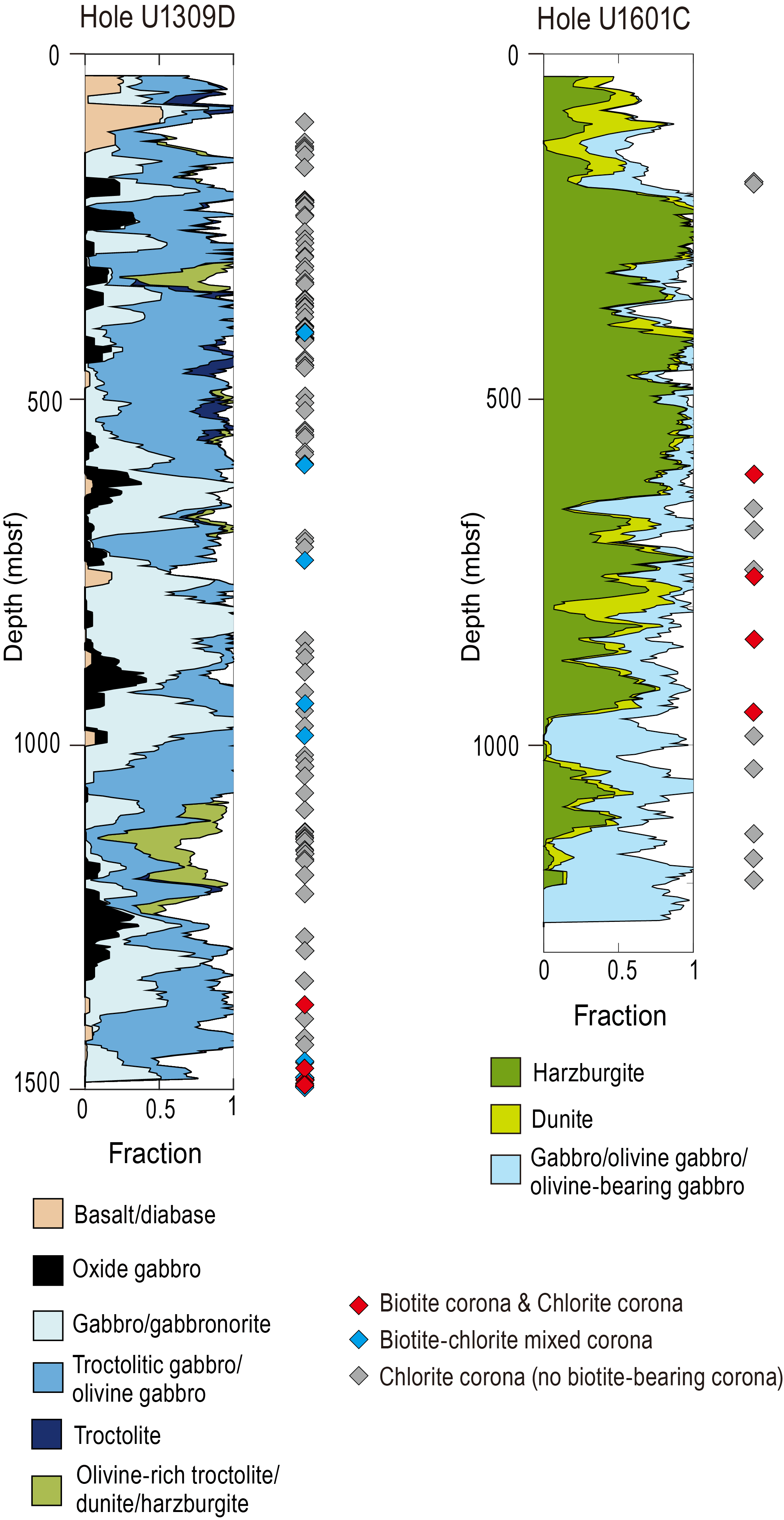
Figure F1. Lithologic variation.
The coronae are tens to hundreds of micrometmers wide and typically composed of an outer layer of chlorite replacing plagioclase and an inner layer of amphibole ± talc replacing olivine. They also contain opaque phase (probably magnetite) associated with amphibole and/or talc replacing olivine. Olivine was also replaced commonly by serpentine and locally by smectite (and sulfide) after the corona formation (Nozaka et al., 2008; Nozaka and Fryer, 2011).
Biotite occurs instead of or associated with chlorite in the coronitic aggregates. Because the biotite is colorless in plane-polarized light, it is distinguished from chlorite by birefringence, specifically interference colors produced by crossed polarizers. In this study, the biotite/chlorite aggregates were classified into three types: biotite corona, chlorite corona, and biotite–chlorite mixed corona, which have distinctly high, low, and intermediate birefringence, respectively (Figure F2). The three types of coronae can occur in the same sample, and heterogeneous birefringence in some coronae indicates that the proportion of biotite/chlorite within individual mixed coronae is variable (Figure F2F).
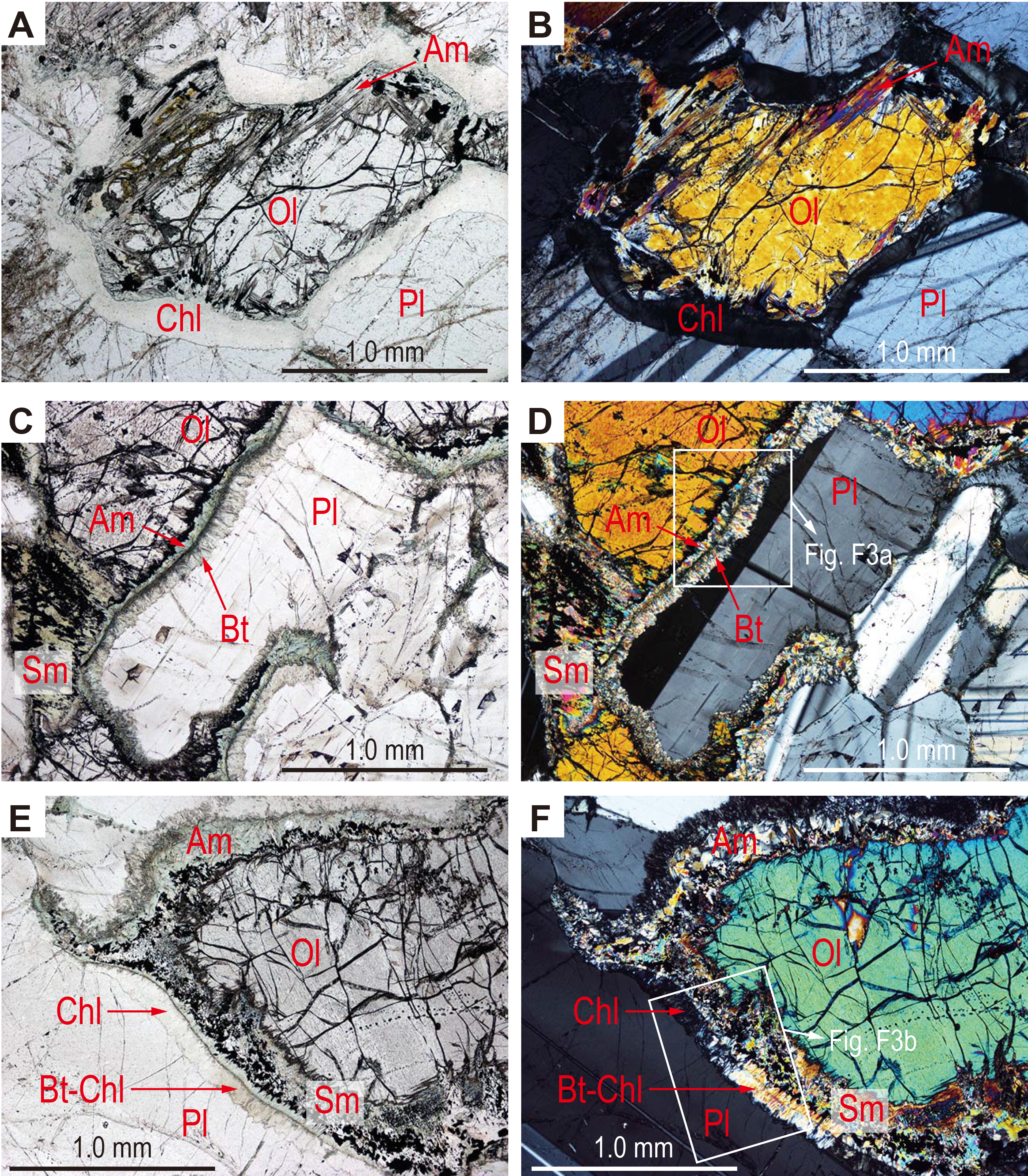
Figure F2. Biotite/chlorite coronae.
Corona-forming amphibole is colorless or pale green in chlorite coronae, whereas in biotite and biotite–chlorite coronae, it tends to be pale green in the proximity of olivine and darker green in the proximity of biotite/chlorite layers (Figure F2).
3.2. Mineral chemistry
Chemical compositions of primary minerals are almost constant in each sample and variable between samples. Olivine has Fo (or Mg#) (= 100 Mg/[Mg + Fe] mol) ~55–85, clinopyroxene has Mg# ~70–88, and plagioclase has An (= Ca/[Ca + Na] mol) ~60–75 with K2O < 0.03 wt% (Table T1).
Corona-forming minerals are heterogeneous in composition even within individual coronae (Figure F3). For example, biotite-dominant domains tend to be richer in Fe than chlorite-dominant domains in the same corona, which makes the former brighter in backscattered electron images (Figure F3B, F3D, F3F, F3H). Increases of Fe and K in biotite–chlorite coronae at contacts with relatively Fe-rich chlorite–amphibole veins are obvious in some samples (Figure F3D, F3H), indicating an effect of Fe-rich fluid injection along microcracks.
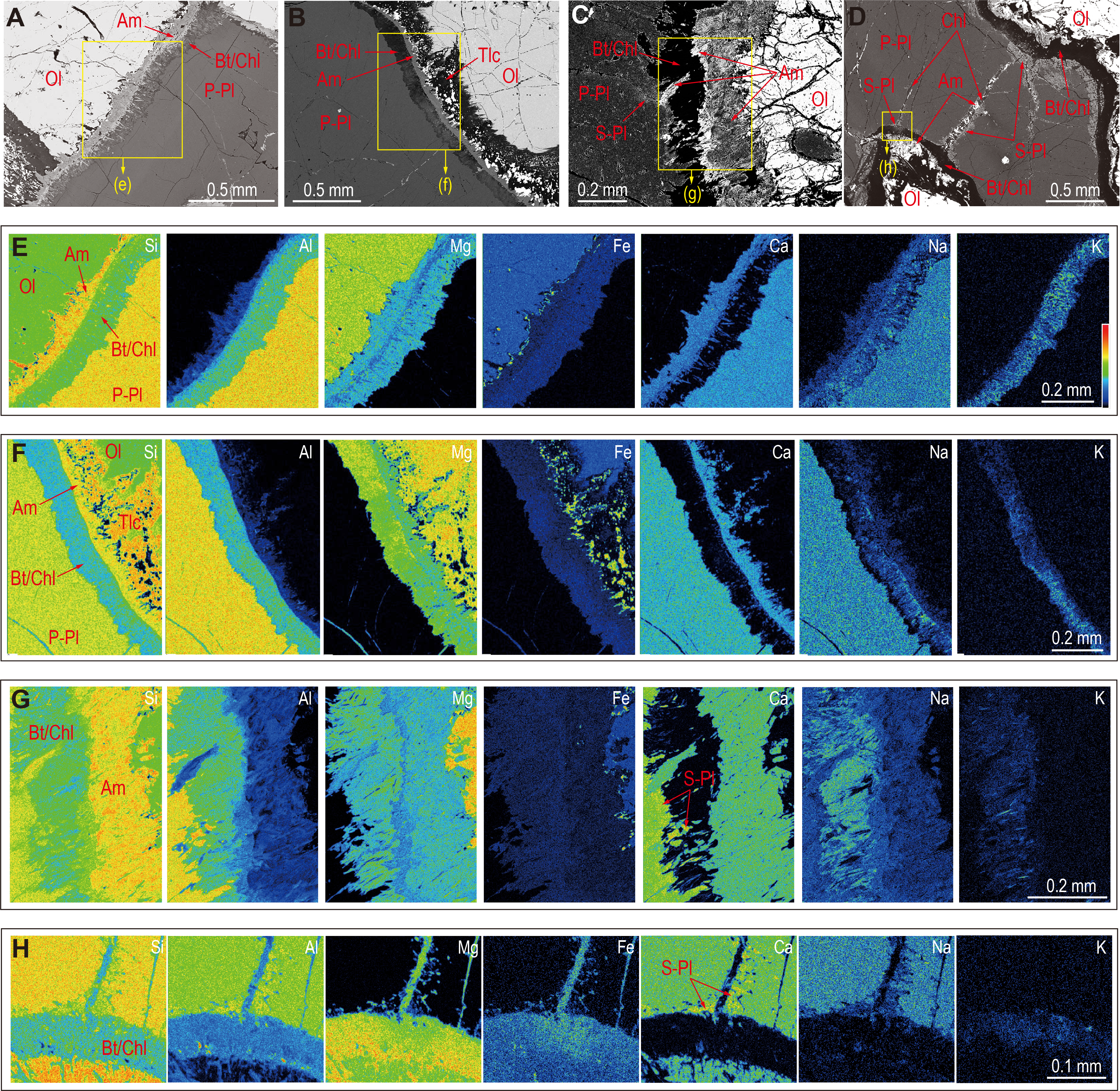
Figure F3. Backscattered electron images and Kα X-ray intensity maps.
Biotite and biotite–chlorite mixtures have compositions between eastonite, Na eastonite (aspidolite), and chlorite with Mg# ranging ~70–95 (Figure F4; Table T2). Their F and Cl contents are <0.03 wt% in most cases and 0.1–0.2 wt% in a few exceptional cases (Table T2). Biotite from the Atlantis Massif has somewhat different compositions from that of the Atlantis Bank, which tends to be relatively rich in phlogopite component and halogens (Figure F4) (Nozaka et al., 2019).
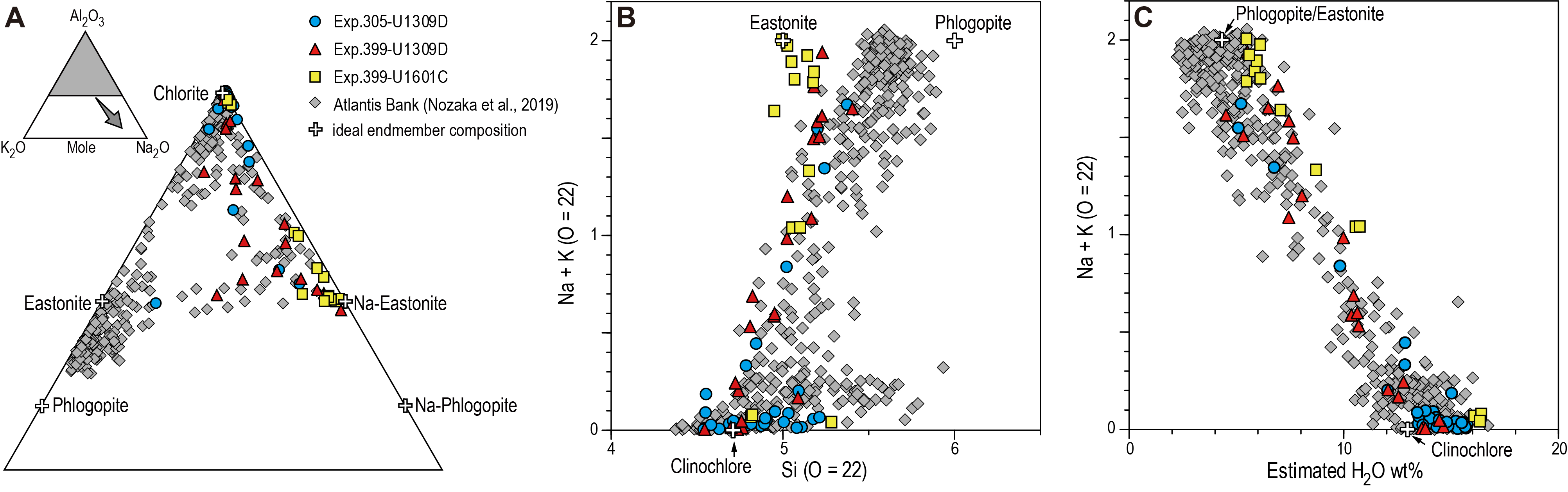
Figure F4. Biotite/chlorite in coronitic aggregates.
Amphibole in coronitic aggregates has variable compositions (Figure F5; Table T3) with a tendency to be tremolitic (Si > 7.5 and Na + K < 0.3 per formula unit of amphibole; darker in Figure F3C) in the proximity of olivine and hornblendic to pargasitic (Si = 6.0–7.5 and Na + K = 0.3–1.0; brighter in Figure F3C) in the proximity of chlorite/biotite layers. This compositional variation of coronitic amphibole of the Atlantis Massif is similar to that of the Atlantis Bank (Nozaka et al., 2019).
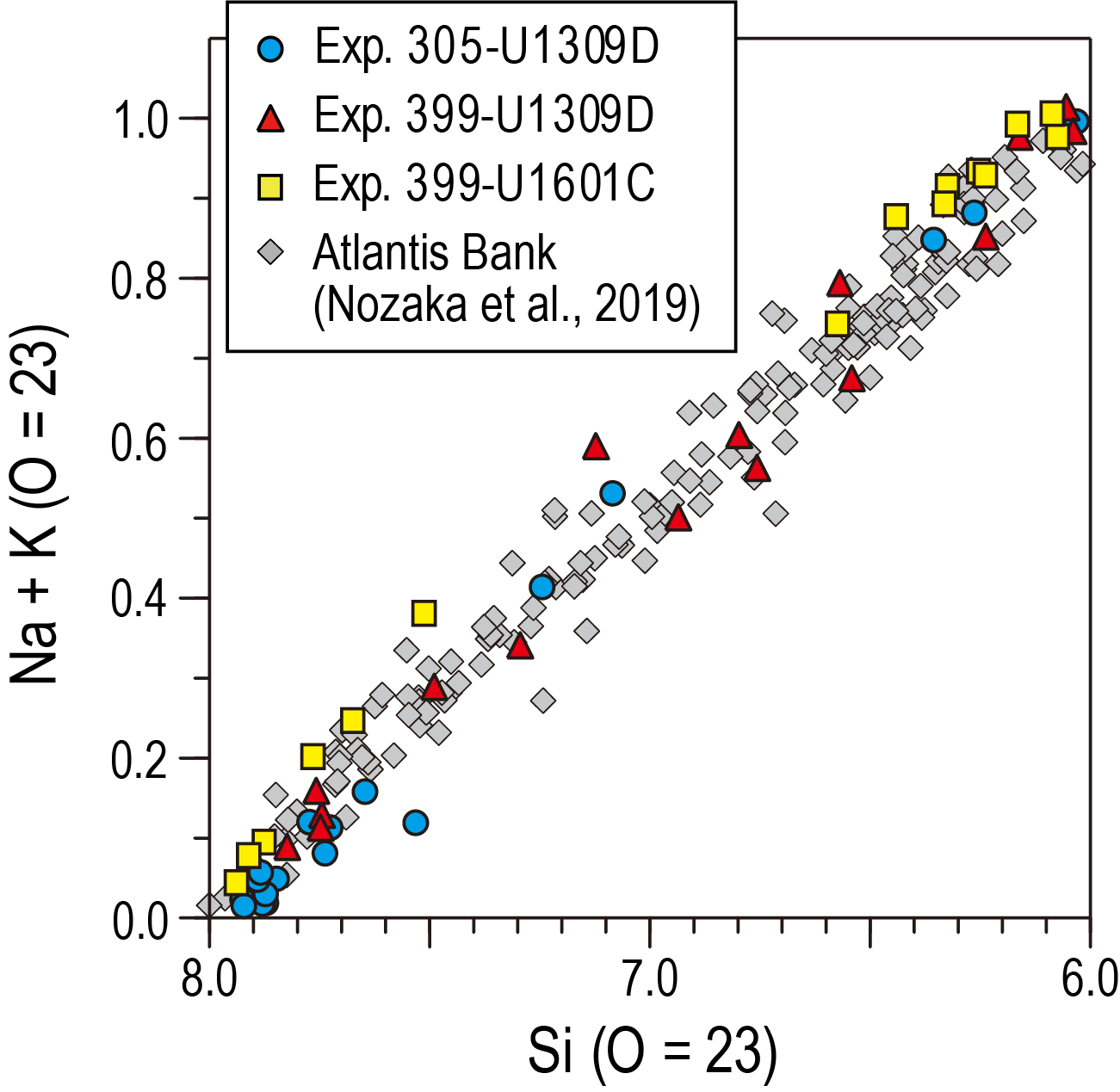
Figure F5. Na + K versus Si.
The An content of plagioclase locally increases to ~75–90 (Table T1) near coronitic aggregates and amphibole–chlorite veins (S-Pl in Figure F3). The geothermometer of Holland and Blundy (1994) for this secondary plagioclase and adjoining amphibole indicates temperatures of 760°–890°C at 1 kb and 770°–900°C at 2 kb, which is almost the same as estimated temperatures for the biotite-bearing corona formation at the Atlantis Bank (Nozaka et al., 2019).
3.3. Raman spectra
The submicroscopic mixing of biotite and chlorite in coronitic aggregates inferred from optical and chemical features was confirmed by Raman spectra, referring to the literature (Wang et al., 2015). Figure F6 shows that all the three types of coronae (biotite, chlorite, and biotite–chlorite) based on microscopic observation have similarly overlapping Raman-shift peaks of both biotite and chlorite as reported previously (Nozaka et al., 2019), indicating that the two minerals are more or less mixed with each other in the analyzed coronae.
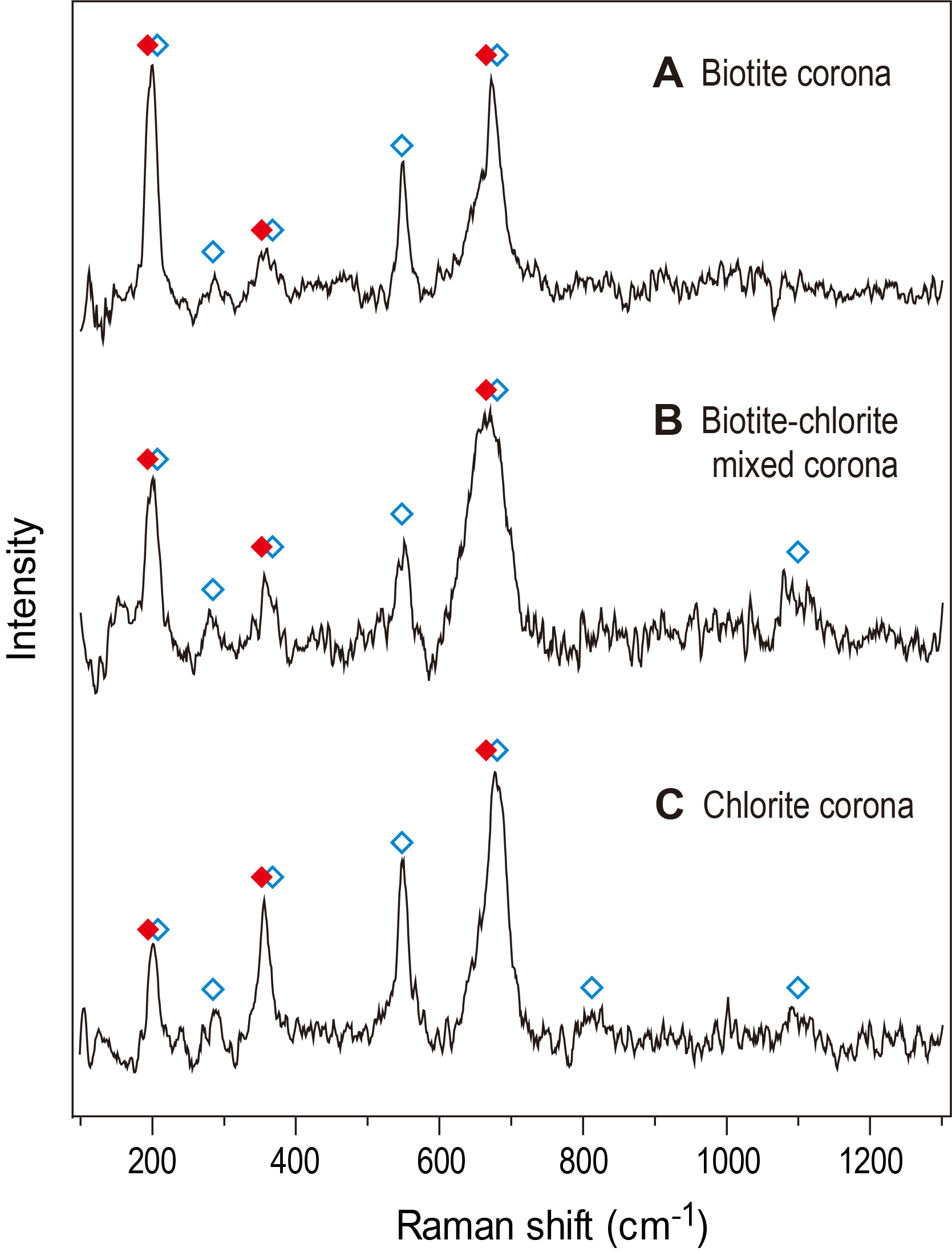
Figure F6. Raman-shift spectra of biotite/chlorite layers.
4. Closing remarks
Biotite-bearing coronae surrounding olivine occur in gabbroic rocks from Holes U1309D and U1601C, although not so abundantly as in the Atlantis Bank. Modes of occurrence and chemical compositions of biotite and associated chlorite, amphibole, and plagioclase indicate that biotite was formed by hydrothermal reactions between primary plagioclase and olivine at an amphibolite-facies condition. The deficiency of K in primary plagioclase and the heterogeneous distribution and amount of An-rich secondary plagioclase prompts a question: what and/or where is the source of K and Na to form biotite? In the case of the Atlantis Bank, biotite formation was probably promoted by magmatic activity that formed abundant felsic or dioritic veins (Nozaka et al., 2019). Although less abundant, felsic or dioritic veins with high alkali contents also occur in the Atlantis Massif (Expedition 304/305 Scientists, 2006; Lang et al., 2025; McCaig et al., 2025); however, whether or not they have a genetic link with biotite formation in gabbroic rocks is unclear and should be solved by future studies.
5. Acknowledgments
The samples used in this study were provided by the International Ocean Discovery Program. This study was supported by funds from Japan Drilling Earth Science Consortium, Japan Agency for Marine-Earth Science and Technology, and JSPS KAKENHI Grant Number 23K0352805. I thank Carlotta Ferrando for reading the manuscript and providing valuable comments.
References
Bence, A.E., and Albee, A.L., 1968. Empirical correction factors for the electron microanalysis of silicates and oxides. The Journal of Geology, 76(4):382–403. https://doi.org/10.1086/627339
Evans, G.N., Charin, S., Seyfried, W.E., and Zheng, X.-Y., 2024. The role of mafic intrusions in producing alkaline vent fluids at the Lost City Hydrothermal Field: evidence from stable potassium isotopes. Geochimica et Cosmochimica Acta, 386:84–95. https://doi.org/10.1016/j.gca.2024.08.030
Expedition 304/305 Scientists, 2006. Site U1309. In Blackman, D.K., Ildefonse, B., John, B.E., Ohara, Y., Miller, D.J., MacLeod, C.J., and the Expedition 304/305 Scientis, Proceedings of the Integrated Ocean Drilling Program, 304/305: College Station, TX (Integrated Ocean Drilling Program Management International, Inc.). https://doi.org/10.2204/iodp.proc.304305.103.2006
Gillis, K.M., Snow, J.E., Klaus, A., Guerin, G., Abe, N., Akizawa, N., Ceuleneer, G., Cheadle, M.J., Adrião, Á., Faak, K., Falloon, T.J., Friedman, S.A., Godard, M.M., Harigane, Y., Horst, A.J., Hoshide, T., Ildefonse, B., Jean, M.M., John, B.E., Koepke, J.H., Machi, S., Maeda, J., Marks, N.E., McCaig, A.M., Meyer, R., Morris, A., Nozaka, T., Python, M., Saha, A., and Wintsch, R.P., 2014. Hole U1415J. In Gillis, K.M., Snow, J.E., Klaus, A., and the Expedition 345 Scientists, Proceedings of the Integrated Ocean Drilling Program, 345: College Station, TX (Integrated Ocean Drilling Program). https://doi.org/10.2204/iodp.proc.345.110.2014
Holland, T., and Blundy, J., 1994. Non-ideal interactions in calcic amphiboles and their bearing on amphibole-plagioclase thermometry. Contributions to Mineralogy and Petrology, 116(4):433–447. https://doi.org/10.1007/BF00310910
Lang, S.Q., McCaig, A.M, Blum, P., Abe, N., Brazelton, W., Coltat, R., Deans, J.R., Dickerson, K.L., Godard, M., John, B.E., Klein, F., Kuehn, R., Lin, K.-Y., Lissenberg, C.J., Liu, H., Lopes, E.L., Nozaka, T., Parsons, A.J., Pathak, V., Reagan, M.K., Robare, J.A., Savov, I.P., Schwarzenbach, E., Sissmann, O.J., Southam, G., Wang, F., and Wheat, C.G., 2025. Site U1601. In McCaig, A.M., Lang, S.Q., Blum, P., and the Expedition 399 Scientists, Building Blocks of Life, Atlantis Massif. Proceedings of the International Ocean Discovery Program, 399: College Station, TX (International Ocean Discovery Program). https://doi.org/10.14379/iodp.proc.399.104.2025
MacLeod, C.J., Dick, H.J.B., Blum, P., Abe, N., Blackman, D.K., Bowles, J.A., Cheadle, M.J., Cho, K., Ciazela, J., Deans, J.R., Edgcomb, V.P., Ferrando, C., France, L., Ghosh, B., Ildefonse, B.M., Kendrick, M.A., Koepke, J.H., Leong, J.A.M., Chuanzhou, L., Qiang, M., Morishita, T., Morris, A., Natland, J.H., Nozaka, T., Pluemper, O., Sanfilippo, A., Sylvan, J.B., Tivey, M.A., Tribuzio, R., and Viegas, L.G.F., 2017. Site U1473. In MacLeod, C.J., Dick, H.J.B., Blum, P., and the Expedition 360 Scientists, Southwest Indian Ridge Lower Crust and Moho. Proceedings of the International Ocean Discovery Program, 360: College Station, TX (International Ocean Discovery Program). https://doi.org/10.14379/iodp.proc.360.103.2017
McCaig, A.M., Lang, S.Q., Blum, P., Abe, N., Brazelton, W., Coltat, R., Deans, J.R., Dickerson, K.L., Godard, M., John, B.E., Klein, F., Kuehn, R., Lin, K.-Y., Lissenberg, C.J., Liu, H., Lopes, E.L., Nozaka, T., Parsons, A.J., Pathak, V., Reagan, M.K., Robare, J.A., Savov, I.P., Schwarzenbach, E., Sissmann, O.J., Southam, G., Wang, F., and Wheat, C.G., 2025. Site U1309. In McCaig, A.M., Lang, S.Q., Blum, P., and the Expedition 399 Scientists, Building Blocks of Life, Atlantis Massif. Proceedings of the International Ocean Discovery Program, 399: College Station, TX (International Ocean Discovery Program). https://doi.org/10.14379/iodp.proc.399.103.2025
Nakamura, Y., and Kushiro, I., 1970. Compositional relations of coexisting orthopyroxene, pigeonite and augite in a tholeiitic andesite from Hakone Volcano. Contributions to Mineralogy and Petrology, 26(4):265–275. https://doi.org/10.1007/BF00390075
Nozaka, T., Akitou, T., Abe, N., and Tribuzio, R., 2019. Biotite in olivine gabbros from Atlantis Bank: evidence for amphibolite-facies metasomatic alteration of the lower oceanic crust. Lithos, 348–349:105176. https://doi.org/10.1016/j.lithos.2019.105176
Nozaka, T., and Fryer, P., 2011. Alteration of the oceanic lower crust at a slow-spreading axis: insight from vein-related zoned halos in olivine gabbro from Atlantis Massif, Mid-Atlantic Ridge. Journal of Petrology, 52(4):643–664. https://doi.org/10.1093/petrology/egq098
Nozaka, T., Fryer, P., and Andreani, M., 2008. Formation of clay minerals and exhumation of lower-crustal rocks at Atlantis Massif, Mid-Atlantic Ridge. Geochemistry, Geophysics, Geosystems, 9(11):Q11005. https://doi.org/10.1029/2008GC002207
Nozaka, T., Meyer, R., Wintsch, R.P., and Wathen, B., 2016. Hydrothermal spinel, corundum and diaspore in lower oceanic crustal troctolites from the Hess Deep rift. Contributions to Mineralogy and Petrology, 171(6):53. https://doi.org/10.1007/s00410-016-1266-4
Seyfried, W.E., Pester, N.J., Tutolo, B.M., and Ding, K., 2015. The Lost City hydrothermal system: constraints imposed by vent fluid chemistry and reaction path models on subseafloor heat and mass transfer processes. Geochimica et Cosmochimica Acta, 163:59–79. https://doi.org/10.1016/j.gca.2015.04.040
Wang, A., Freeman, J.J., and Jolliff, B.L., 2015. Understanding the Raman spectral features of phyllosilicates. Journal of Raman Spectroscopy, 46(10):829–845. https://doi.org/10.1002/jrs.4680